Showing posts with label Journalism. Show all posts

2/10/19

Spotting Fake News

I recently saw Carl Bernstein and Bob Woodward speak at Macomb Community College. It was really, really great. However, I was disappointed with the fact that they were not answering the audience questions directly, or very well. They dropped into stories a bunch and that was totally awesome.

The question that irked me the most that was asked and not answered: How can you tell if something is fake news?

The question is painfully relevant and these two titans of journalism and reporting just did not have an answer beyond "I don't know."

Here are some of my suggestions:

  1. "Call a librarian," was the suggestion from my pal that attended Bernstein/Woodward. We're trained to spot fake news and can help you out.
  2. Check where the source appears on this chart. The higher and more toward the center, the better quality and less bias you can expect.
  3. A couple quick tells are also looking at the "About" or "Contact" section. If neither section exists, that's a red flag. 
  4. No bylines - no deal. If you are reading stuff that doesn't have an author attributed to it, move along. Any dope, malicious person, talking head or other jerky can plop anything online, so if you can't track where it's coming from, it's probably junk.
  5. Memes aren't news. That's it. Do better.

7/1/17

Happy Belated, George Orwell!

I can't believe I missed George Orwell's birthday! Luckily, The Writer's Almanac reminded me. He was born on June 25, 1903 in Motihari, India and wrote two of my favorite novels: Animal Farm and 1984. Those novels, I feel, are uncomfortably relevant today in the United States. The Writer's Almanac selected a quote that gave me chills...
“In a time of universal deceit, telling the truth is a revolutionary act.”
Ya heard?

7/7/15

Year of Gratitude - Day 188 - Mother Jones

While now I follow the publication on Facebook, I found out that:
"On July 7, 1903, Mary Harris "Mother" Jones began the "March of the Mill Children" from Philadelphia to President Theodore Roosevelt's Long Island summer home in Oyster Bay, NY, to publicize the harsh conditions of child labor and to demand a 55-hour work week. 
That's from the Zinn Education Project Facebook (which is also great).  They have this awesome bio on her on the website. I loved this part of the passage (emphasis added):
Mother Jones, honored today by the political magazine that bears her name, lived in a time when women were not allowed to vote. “You don’t need a vote to raise hell,” she said about that. “You need convictions and a voice.” She perhaps is best known for her saying, “Pray for the dead, and fight like hell for the living.”
This was an incredible women that lived through some pretty serious hardships, including losing four children to yellow fever and everything she owned in a fire after that. Yet, she lived. She truly lived.

12/25/12

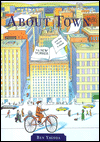
Book Review: About Town

About Town: The New Yorker and the World it Made
By Ben Yagoda

Lately I've been really focusing on the enjoyment of books and writing again. My lack of reading, then lack of writing and subsequent lack of knowledge consumption and creation has gone on too long. About Town would normally have taken me much longer to finish, but I got in there quick and stayed absorbed, even though I took many breaks for notes and looking up words. Glad I was in this mode for this title; it was quite good. It wove together some of my favorite things - writing, history and The New Yorker.

As I prepared to write, I realized that I am likely going to read most of Ben Yagoda's books. Initially I thought this was one of my wildcard books, but then realized I added it to my reading list when after I read Yagoda's Memoir: A History. My experience reading this book was very different from reading the book about memoirs. It was interesting even when it went into lists, which I didn't like in Memoir. I think I read a review that said About Town was slow moving and while I can see that being possible, I really enjoyed the book more as I read along. This history of The New Yorker made me conjure lists of my own and I really enjoyed this non-fiction reading experience.

First, this book really grew my reading list and reminded me of some titles I've forgotten to transfer to new lists. There are a couple works that I thought to reread, namely Hiroshima and In Cold Blood. Most of the new stuff on the list appears to be non-fiction, but I was dazzled by all the great authors and specific works named in About Town. There are actually a lot of interesting pieces published in other magazines, which are noted. The list is mostly in chronological order.
  • Book: Keep Your Head Down by Walter Bernstein, 1945. Collection of the New Yorker's articles/letters on WWII.
  • "The Beautiful Spoils" by Janet Flanner, 1947. Piece about the Nazi's plunder of art during WWII.
  • Essay in Holiday by E.B. White: "Here is New York", 1948
  • Fiction: "The Enormous Radio" by John Cheever, 1947. The story is about a radio that starts transmitting other people's lives.
  • Eichmann in Jerusalem: A Report on the Banality by Hannah Arendt. I've only read some of this book for a class. Heavy stuff, but I must get back to it.
  • Silent Spring by Rachel Carson. Same thing, this is a book that I have to get back to.
  • The Fire Next Time by James Baldwin. Book of two important essays on race relations.
  • "The Honoured Society" by Norman Lewis. About the mafia.
  • Look into profiles published in Esquire by author Gay Talese on Frank Sinatra, Joe Louis and Joe DiMaggio.
  • Wanted to look up pretty much anything by Richard Harris. My notes indicate that in 1966 he detailed how the American Medical Association sabotaged Medicare. Interestingly, in 1968 he also wrote about how the National Rifle Association sabotaged gun legislation. It would be fascinating to read about these issues from the 1960s perspective.
  • "Village of Ben Suc" by Jonathen Schell, July 15, 1967
  • Talk piece on Milton and Rose Friedman in the form of an expense account by Jamaica Kincaid.
  • Book: Happy to Be Here and short story "Local Family Keeps Son Happy", both by Garrison Keillor. I love that guy.
  • "A Welfare Mother" by Susan Sheehan, 1975
Honestly, I'm looking at this list and think there there's a lot I didn't take note of. I really thought the writing allowed for quick reading, which pulls me away from taking those kinds of pauses in reading. So much great stuff in this book. It got hard to keep track.

Okay, so the other list I found myself developing was that of words, some new, some I just never took the time to look up or remember how to spell. There were a lot of interesting words to feast one's eyes one.
  • contrivance
  • hokum
  • solecism
  • ostentatious
  • faux-naif
  • acerbic
  • filial
  • palsy
  • deleterious
  • prescience
  • ennui
  • elegiac
  • calumny
  • jeremiad
That's good stuff.

Merry Christmas!

2/24/08

Book Review: Made to Stick

Made to Stick, By Chip and Dan Heath

Man, oh, man, this book was excellent. It was a recommendation by my library brother-in-arms, B-Money. This book is basically about making ideas stick in people's minds. How do you make people remember? How do you make people care? The book was great and it's value, for writers especially, is on par with On Writing Well. The book is VERY well-written (as it should be), clear, concise and it also provides little "clinics" to highlight good, bad and okay messages. Plus, there are a mountain of great anecdotes and examples.

The rest of this review contains the notes I took on the book. Highly, highly recommended for everyone that has a message: public relations, teachers, organizations, etc, etc. Pretty much everyone that needs to connect with others - meaning everyone.

Emotion chapter - If people are analytical, they are less charitable. If people are made to FEEL first, they're more charitable. Essentially, if one is asked to be analytical first, chances are they will care less. An excellent example is the Truth anti-smoking campaign versus Big Tobacco's anti-smoking campaign (big surprise, huh?). This example illustrates that helping teens rebel against "the man" (Truth campaign) is more effective than asking them to "Think. Don't smoke." (Big Tobacco's campaign). The Truth campaign has been successful in greatly reducing teenage smoking, because the campaign encourages teens to stick it to The Man (in this instance, Big Tobacco). In essence, sticking it to The Man is way cooler than thinking. Indeed.

There is a discussion of the overuse of terms and how people get desensitized. Some great examples are: relativity, unique and sportsmanship. I liked how one of the books anecdotes changed "sportsmanship" to "honoring the game", which is brilliant. Again, this little tweak helped a guy who's in charge of a coach's clinic to decrease technical fouls and bad (parental) behavior in a number of sports leagues in California. "Honoring the Game" is much more concrete and less cliche than "Be a good sport" or something like that.

Page 198 talks about how Texas had to figure out how to decrease roadside pollution. They came up with "Don't mess with Texas" and getting the attention of the macho, gun-wielding, truck-driving Texans. Roadside pollution decreased 29% in one year and 72% over the next five. Winner: Texas.

Stories chapter - This passage made me smile. It's about a guy that at first is upset because a group of business guys' attitude changes from crappy to open when they realize how good HIS idea is...

"...he thought a happier thought 'How wonderful! They've stolen my idea! It's become their idea!'"

This made me think of all types of things: plagiarism, blogging, web code and open source software. And it also made me think that, yes, if someone wants your idea, that means it must be pretty good. If someone is willing to make it theirs, it's sweet and essentially puts you in the drivers seat. Ideas start free and help you take off, start a project, business, etc. And then better ideas form.

One last interesting piece of info: there is almost no correlation that emerges between "speaking talent" and the ability to make ideas stick. The people who were captivating speakers typically do no better than others in making ideas stick. Basically, many good speakers can be mistaken for good bull****ers. A great example includes a bunch of Stanford kids who think they're sweet, but turns out their ideas are about as sticky as cooking oil.

This is just the tip of the iceberg in this book. There are so many fascinating stories and examples that this blog just can't do it justice. Read this book. Period.

2/13/08

Book Review: Bad News

Bad News, by Tom Fenton
The full title of this book is Bad News: the decline of reporting, the business of news, and the danger to us all. Although all things journalism interest me, this book did not. Here's my story...

First, it was primarily about television journalists (which sounds like an oxymoron). I think what Fenton tried to do was discuss broadcast news overall, but he bearly touched on radio or internet news. I've always had a bias for the print journalists out there and this book reenforced that sentiment. So, the subject matter was not my favorite.

The book was also slightly out of date which is more my fault for picking it up 3 years after publication. Generally, "better late than never" is a good rule to go by, but "never" would have been a better plan when it came to reading this book. There is some mention of Iran still producing nuclear arms, which turned out to be wrong. The author shows his age as he claims, essentially, that young people don't care about foreign news. Of course, mentions of blogs, online reporting and the like are almost non-existent in this book. I find it funny that Fenton bags young people when he doesn't even mention some of the most popular media outlets. He scoffs at the Daily Show and condescends more than a few times.

The writing was pretty bad. I thought maybe it was just kind of boring, but I longed for the ending and seriously thought it would never come. I was mostly skimming by the end. There was a lot of material to work through, especially some background on Russia, China, the Middle East and the variety of ways they're tied together (through oil, war, policy, etc). There was too much material and not enough good, engaging writing to put it all together. I'm still deciding if I learned anything new from it. Ironically enough, it seemed as though it was a bunch of print journalists' materials regurgitated into this guy's book.

Not only was the subject matter dated, but technical aspects of the writing were weak. I found a typo at the beginning of each chapter and I think I came across a misspelling as well. There were some good quotes from some big-time broadcasters, but far more were bad. They either went on too long or were spliced up by so many commas, one didn't know when to pause and when to think. I also didn't feel there were tons of facts to back up Fenton's claims. Finally, this book is chock full of questions. They're EVERYWHERE. I saw more question marks where I rather would have seen either answers or thoughtful insight.

I do not recommend this book. I'm actually reading a very nice contrast called Made to Stick, which talks about creating successful ideas. A lot of it is about writing and all of it provides better insights on ways the media could improve (even though that's NOT the main goal of the book). I will be sure to review that one, as well.

Fenton's book is more a book of complaints and questions that take the reader in rhetorical circles.