A repost:
My friends and I are constantly sharing poems with each other. SO MANY POEMS. Since April is National Poetry Month, I wanted to share one of my very favorites, a poem called "The End and the Beginning" by Polish poet, Wislawa Szymborska. I love it more each time I read it. It really speaks to my Polish heritage.
The End and the Beginning
by Wislawa Szymborska
After every war
someone has to clean up.
Things won't
straighten themselves up, after all.
Someone has to push the rubble
to the side of the road,
so the corpse-filled wagons
can pass.
Someone has to get mired
in scum and ashes,
sofa springs,
splintered glass,
and bloody rags.
Someone has to drag in a girder
to prop up a wall,
Someone has to glaze a window,
rehang a door.
Photogenic it's not,
and takes years.
All the cameras have left
for another war.
We'll need the bridges back,
and new railway stations.
Sleeves will go ragged
from rolling them up.
Someone, broom in hand,
still recalls the way it was.
Someone else listens
and nods with unsevered head.
But already there are those nearby
starting to mill about
who will find it dull.
From out of the bushes
sometimes someone still unearths
rusted-out arguments
and carries them to the garbage pile.
Those who knew
what was going on here
must make way for
those who know little.
And less than little.
And finally as little as nothing.
In the grass that has overgrown
causes and effects,
someone must be stretched out
blade of grass in his mouth
gazing at the clouds.
Showing posts with label War. Show all posts
Showing posts with label War. Show all posts
4/6/20
12/8/12
Book Review: Alas, Babylon

By Pat Frank
When one feels like they are having a bad day, or week, or month, or even year, one can always pick up a post-apocalyptic classic novel and realize, "Hell, things could be worse." Alas, Babylon was exactly what I needed: a nightmarish classic, with excellent writing, good dialogue and interesting, but not obnoxious characters. This is a wonderful book.
While the meat and potatoes of this story was the fact the United States was in a nuclear war with the Soviet Union back in the red scare era, it is really so much more. I loved how Frank wove in all types of story elements - including psychology, racism, violence, feminism, romance. Although I'm not a huge fan of the zombie stuff out now, I think those types of stories were inspired by Frank. He shows us how greed can destroy, poverty and hunger can turn people to animals and how a community can come together to overcome incredible change. Of course, my favorite part of the book was what a huge part the library played after the nuclear holocaust. With no electricity, you had to read and research the old fashioned way. The librarian and local teacher become the center of the community's education. It's kind of strange to think about.
It's interesting to see imagine how people react when it's just humanity versus the elements and no modern luxuries like electricity in between. I thought the Black Out of 2003 was pretty apocalyptic and that lasted just a few days. What a damn fiasco. It was bad when the super storm hit New York, but then things started getting back to normal slowly. In Alas, Babylon, the author explores further and further beyond a complete nuclear showdown to end all showdowns. No electricity, hardly any government left, and a significantly harmed planet. It made me think of a quote by Albert Einstein: "I know not with what weapons World War III will be fought, but World War IV will be fought with sticks and stones."
Come on, doesn't that make you feel better about life already?
At the end of the book, I loved learning more about Frank. He was born in Chicago, IL and went to Florida for college. He dropped out and became a journalist and then an information professional and consultant in Washington. Guy sounded like a bad ass. It'd be interesting to review his other literary and journalistic works.
I only picked up one quote from the book, but it a perfect quote for me right now. It's about the protagonist: "In everything he did, now, he found he looked into the needs of the future."
Indeed.
---
See what else I read: http://pinterest.com/evagg/books-i-ve-read/
6/23/09
Book Review: The Shock Doctrine - The Rise of Disaster Capitalism
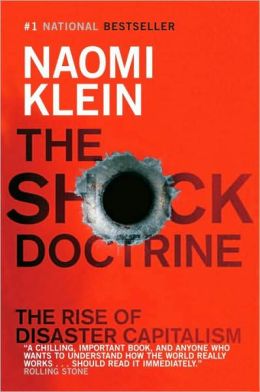
Klein makes the book's purpose clear in this early paragraph:
"This book is a challenge to the central and most cherished claim in the official story - that the triumph of deregulated capitalism has been born of freedom, that unfettered free markets go hand in hand with democracy. Instead, I will show that this fundamentalist form of capitalism has consistently been midwifed by the most brutal forms of coercion, inflicted on the collective body politic as well as on countless individual bodies. The history of the contemporary free market - better understood as the rise of corporatism - was written in shocks." (p. 18)There it is. Game over. Klein wins. She really pulls this off and the product is freaking stunning. I'm in shock and I could probably be swindled into making some bad life decisions after just reading this book. Just kidding. But it is a must read for history buffs, political junkies and economy watchers. My friend says she continues to refer to The Shock Doctrine even though it was published in 2007. The accuracy of Klein's pondering is eerie.
The Shock Doctrine is not for the weak of heart. It gives you (and hope in humanity) a swift kick to the throat over and over through recent histories backed up with painfully sound evidence. It'd be great if it was all exaggerated, but you can't make this stuff up. After one emerges from the gloom created by the reading of this book, the last ten or so pages wraps it up with hope. With all the delivery of doom, Klein does a tremendous job of putting things into perspective and actually inspiring hope in humanity. It was another brick in my belief Detroit can rise from the shock it has been in, you know, since the late sixties.
There are two particularly evil characters in this book: Milton Friedman and the Chicago School of Economics. Klein described Friedman is as the guru of unfettered capitalism. He is cast as the super villain and for good reason. He's the guy that sparked the idea of shocking a country's economy through privatization, deregulation, hollow government and completely free enterprise. Although, I am not a fan of this, I'm wondering what it will take to get Detroit back on the right path. Perhaps not a shock, but a damn wake up call is needed in Detroit government. I digress.
The other character, which spawns a slew of others throughout the book, is Friedman's homebase: the Chicago School of Economics. There only the finest crooks were molded, from leaders of junta governments to (dangerous) jokers like Donald Rumsfield. Milton and the "Chicago School" were on a crusade to spread free-wheeling capitalism and cloaked it with the word "democracy." Basically, they wanted to bank off other people's money. They did, but it is interesting to hear about their fall from grace. I'm fascinated by their failures.
Klein's perspective is brilliant. She makes many relevant connections, historical observations and she even nailed a few predictions, like how this system was going to fall apart. There's only so much people will take and only so much money you can bag before someone starts wondering where the hell it all went. Though packed tight with information, it could be read again and again and you'd learn something new each time. Klein's writing is clear and the prose pieces together a history lesson with a call to grassroots. Good stuff.
The journey that Klein takes you on in the Shock Doctrine starts in South America's Southern Cone - in Chili, Argentina and Uruguay. There's some mentions of Colombia, Bolivia and Brazil as well. Chili was Friedman's first shock experiment and there's all kinds of info on the kind of crazy stuff that went on - torture, misery villages, disapperings and American-backed coups. Not cool.
Then we are shown examples ALL OVER THE FREAKING WORLD. Seriously: China, Russia, Poland, South Africa, Lebanon, Sri Lanka, Iraq, and, of course, the United States itself. I probably missed a few. What a ride.
It was a little strange to be reading The Shock Doctrine now when it was published in 2007. Though Klein manages to let the facts speak loudly for themselves, one can tell that she is reeling throughout the book about the Bush Administration. The connections between the Administration and multinationals that have sucked the life out of the United States and the world economies are appalling. I'll just leave it at that, but that junk is well documented.
And here are a few notes that I took. I had to really restrain myself from taking too many because it would have taken me two years to finish this thing. Anyway:
"The shift has been starkest in the U.S. where CEOs made 43 times what the average worker earned in 1980, when Reagan kicked off the Friedmanite crusade. By 2005, CEOs earned 411 times as much." (p. 444)Talking about the 400,000 or so Iraqi soldiers Paul Bremer laid off after the U.S. invaded Iraq, Marine Colonel Thomas Hammes said:
"Now you have a couple hundred thousand people who are armed - because they took their weapons home with them - who know how to use the weapons, who have no future, who have a reason to be angry at you." (p. 352)A quick explanation of what shock is. It's an underlying theme throughout the work:
"A state of shock, by definition, is a moment when there is a gap between fast-moving events and the information that exists to explain them."She goes on:
"...in North America, the September 11 attacks were, at first, pure event, raw reality, unprocessed by story, narrative or anything that could bridge the gap between reality and understanding." (p. 458)Finally, this was an interesting point on Hezbollah:
"There is no question that Hezbollah is engaged in politics as well as charity, and that Iranian funds made Hezbollah's generosity possible. Equally important to its efficiency, however was Hezbollah's status as local, indigenous organization, one that rose up from the neighborhoods being rebuilt." (p. 462)There so much more great information in this book. Highly recommended for everyone.
Labels:
Books,
Business,
Capitalism,
Economy,
History,
Iraq,
Milton Friedman,
Natural Disasters,
Politics,
Terrorism,
Tsunami,
War
No comments:

9/26/08
Curious George
I was listening to the Sept. 16 Writer's Almanac podcast - a must-listen for all writers - and heard the amazing story of Hans Augusto Rey and Margret Rey, the creators of Curious George. The two built bikes, took their manuscript and fled Paris in 1941, escaping Hitler's terrible reign. They got to the Spanish border, made it to Brazil and finally to New York, where they published the wonderful books. I thought that was a neat story.
8/6/08
Book Review: Slaughterhouse 5
 Slaughterhouse 5
by Kurt Vonnegut
A little bit ago, I found this cool blog with a bunch of literary tattoos called Contrariwise. Although I highly doubt I'll ever get tattooed, I'm always intrigued by what others decide to burn into their skin indefinitely. I found some repeats: tattoos about the Little Prince, The Giving Tree, Dr. Seuss references, tons of elvish writing and a boatload of Kurt Vonnegut snippets out of Slaughterhouse 5. Hence, I thought that if people were permanently putting his words into their skin, I thought that reading his book would be worthwhile. It was.
This book is essentially about a guy in World War II and the firebombing of Dresden, Germany. It's sort of a mind-bender, as the main character, Billy Pilgrim, travels through time, visits an alien planet and survives the ferocious firebombing of Dresden.
Although there's the science fiction twists of aliens and time travel, I actually think that is a bit of a distraction created by the author. The whole time travel concept really made me think about memory and its preservation. I've heard some criticism about this book minimizing the Holocaust, but I thought nothing of the sort. I actually thought it complimented the entire idea of memory during WWII, but this was a story from a very different perspective, namely, the American soldier perspective.
After each mention of death, there is the pictured phrase, "So it goes." It is repeated many, many times, giving a reader an idea of how often in life we experience death. I have found myself using this little phrase more and more often in my own speech. I guess you really are what you read!

Anyway, here's a couple passages I particularly enjoyed:
"Trout, incidentally, had written a book about a money tree. It had twenty-dollar bills for leaves. Its flowers were government bonds. Its fruit was diamonds. It attracted human beings who killed each other around the roots and
made very good fertilizer.
So it goes." (p. 159)
"Now he quoted Theodore Roosevelt, whom he resembled a lot: 'I could carve a better man out of a banana.'" (p. 176)
7/20/08
Book Review: Chasing the Flame
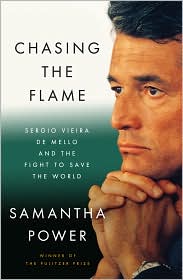 Chasing the Flame
by Samantha Power
After many months, yes, months, of reading this book, I have finally finished. Even though it took me a very long time, it was well worth it. I mentioned that this book shouldn't have made it through my 50-page reading rule, but that was incorrect. The 50-page reading rule did not apply here and I'll explain why later. The book was very dense with information, jammed with a multitude of references and notes, and a biography that was worthy of this great man.
Sergio Vieira de Mello was a humanitarian, peacemaker and state builder with the United Nations. He was a lifelong UN guy and went to all kinds of godforsaken places on all kinds of brutal missions: Lebanon, Cambodia, Rwanda, Kosovo, East Timor and, finally, Iraq, where he died in an Al-Qaeda attack. That's quite the resume o' misery.
Each of these missions had its own goals and every one came with unforeseen problems. A lot of this book was about Vieira de Mello learning on the job. That could easily have been part of the reason why this title was so frustrating to read. Everything seems so much more obvious in hindsight, but he was living through these tragedies and working with limited resources. Although I think he did a ton in his lifetime, it was difficult to look beyond the dysfunctions of the UN, with its red tape, bureaucracy, lame leadership and lack of international support from member states. This man proved he had some patience, cause anyone else would've gone mad.
I have quite the mixed feeling on the UN now. It's not completely their own fault, but I will fault the leadership, namely Kofi Annan, for the disastrous results of the Iraq mission. The other serious flaw with the UN is that the most powerful member states are jerks. They want to have an international group, but won't supply it with personnel, supplies, money, etc. In a sense, I understand that the UN is in theory a great idea, yet in practice destined to fail always.
 I was at a street festival in Ypsilanti, MI a couple weeks back and saw this sign hanging to the right of the stage. Although I don't agree, this book made me understand why this idea persists. I also feel that Americans should look to their own leadership before casting stones at the United Nations.
Initially, I felt that Vieira de Mello was, well, kind of a piece o' crap. He was a charismatic guy, a top-notch schmoozer. He was a womanizer, regularly cheating on his wife, who he would eventually divorce much later in life. Yet, as the book went on, I realized that I was being quite unfair. Although he was not Mr. Committed to Wife, he was Mr. Committed to Work. He gave everything to his work. In the end, he sacrificed his very life.
Vieira de Mello's philosophy and diplomatic techniques were incredibly insightful. He was known for always trying be diplomatic with the bad guys to learn about them, though some faulted him for overlooking various atrocities. He learned to create solutions with minimal resources and was very vocal. Later in his life, he developed an intense philosophy on human rights, which would have served the United States very well in Iraq. He was the first one to tell Paul Bremer, a joker and large reason Iraq is what it is, that the US was poised to have some serious abuse problems. A year after Vieira de Mello's warning, the Abu Ghraib story broke.
Struggling through Vieiro de Mello's first missions seemed very counterproductive at first, but it really provided a very important foundation of understanding about the man. The last 120 pages of the book are very, very intense and that's why the 50-page reading rule does not apply to this book. As a reader, you know it's coming. You can hear the clock ticking on Vieiro de Mello's life and the author makes that ticking louder by describing that day, August 19, 2003, minute-by-minute when possible.
In the end, it is more tragic than one can imagine. I was reading the last parts of the book in a vehicle on the way back home from a trip. I worried by boyfriend because he heard me sniffling in the back seat. Vieira de Mello, even trapped under the rubble that would slowly kill him, only asked about the rest of the people in the building. He asked that the UN not pull out of Iraq. The last passage in the book is probably one of the most striking:
"When he realized he had miraculously survived the blast, he must have expected
that the professional soldiers from the most sophisticated military in history would find a way to extract him from the debris. But as his life seeped slowly out of him, there must have been a moment - hopefully not a long one - when he was every bit as helpless as millions of victims had been before him. He died under the Canal Hotel's rubble - buried beneath the weight of the United Nations itself." (p. 537)
In the end, he was just as much of a human as anyone was. The difference was that he did things that most of us never would. He was selfless, even though it always didn't seem that way, but he was.
Here are my notes from the rest of the book, with page numbers first:
- 17 - "Audacity is the winner's gift," his dad Arnoldo Vieira de Mello said.
- 48 - Vieira de Mello found some gaps in philisophical tools. "Things are much complicated in practice...Philosophical ideas must be applicable on the ground, and the field should be their only judge, their only criteria."
- 59 - "Living is a prelude to death." ~Alexander "Sacha" Casella.
- 73 - Vieiro de Mello was very into philosophy and defended his 600 page thesis. He was really into Kant, who felt that other countries should not interfere w/ others' internal affairs unless the unrest in a country begins to interfere w/ neighboring countries as was the case in 1990's.
- 99 - at this stage in his career (90s and in Cambodia), mulling the roots of evil was more stimulating than managing the logistics of easing the suffering that resulted from that evil.
- 100 Sergio a man who refused to make enemies
- 199 - by this point in the book, he's gone to Lebanon, Cambodia, Bosnia and new Rwanda. All this time the picture I see developing before me is one of external ignorance. The UN, though a good idea, doesn't seem to pan out in real life. So far they just watch situations deteriorate and then kind of play it by ear, but these are enormous catastrophes. I suppose there really is no easy way to deal with tragedy, despair, emergencies, famine, etc.
- 206 generally all the world's countries turning their backs on each other.
- 213 - "we have to choose the least bad option here." Sounds like every UN mission.
- 358 - it seems like he won many small battles, which from the tone of the book sounds impossible. He gets some kind of 2nd wind in 2001, divorced his wife, marries some 20-something he worked with at the UN. Got much more spiritual, very different from his atheist attitude of before.
- 361 - I never realized how much Bin Laden hated the UN. He said "under no circumstance should any Muslim or sane person resort to the United Nations. The United Nations is nothing but a tool of crime."
- 471 - as he lay under rubble, thirsty, with only one arm free, he asks about "the others." He just received his tickets to go to Brazil to visit his mom a day or two before.
- 526 - Vieira de Mello had said, "Think of how hard it is for any of us to change. Why do we expect it to be easier for a war criminal?"
7/18/08
Today's Knowledge: Stop-Loss and the Iraq War
 Just in case you didn't know, the Iraq War is a train wreck. There's all sorts of facts, figures and stories that back this up, but to me the people getting hurt the most (tied only with Iraqi civilians) are our brave military men and women that are fighting this losing battle.
I just learned this new term: stop-loss. Stop-loss is essential when the military tells soldiers that even though they have fulfilled their voluntary duty, they have to go back and serve extra time. I was catching up on my podcasts and learned about all this stuff on Democracynow.org. You can view or listen to (or read the transcript) of the whole show and lots of other stuff there. The story is call: Stop-Loss: A Look at the US Military Policy that Creates a “Backdoor Draft” to Force Soldiers to Continue.
There's a couple different things that you should check out regarding this issue. First, check out Casey J. Porter's YouTube channel. He was stop-lossed three weeks before he was getting out. Now he's in Iraq filming the thoughts and lives of soldiers. You can hear the truth from the soldiers on the ground at his channel: http://www.youtube.com/CaseyJPorter. Very important stuff. Very important work.
Another soldier, Colby Buzzell, was also recently stop-lossed. He is the author of the blog My War: Killing Time in Iraq and he also wrote a book by the same title. He wanted to use his G.I. Bill to get into college and start his life outside of the military. Instead, he's getting shipped back to that US-made mess.
Finally, there's a movie that came out on DVD called Stop-Loss. It was an MTV production, so I think initially I ignored it for that reason, but I'm about to go check it out. I caught a clip of it on Democracy Now and definitely think it's going to be good.
6/20/08
Today's Knowledge: Body of War
This movie is opening up in Ann Arbor, MI today. This is going to be an important movie.

5/3/08
20,000 vets brain injuries not listed in Pentagon tally
At least 20,000 U.S. troops who were not classified as wounded during combat in Iraq and Afghanistan have been found with signs of brain injuries, according to military and veterans records compiled by USA TODAY.
read more | digg story
read more | digg story
War Veterans
The American soldiers need to be taken care of. It's good to see that the Pentagon is starting to shape up on how they treat their psychiatric wounds (see this article about the problem and this article about the progress). I think it's too little too late. I am happy for the development, but a lot of damage has been done.
When it comes to taking care of the soldiers they send to die, the U.S. government has an uncanny ability to fudge things up on a grand scale. Something quite unfortunate always finds a way to surface. Here are some things that the American people should be aware of when it comes to caring for our soldiers:
When it comes to taking care of the soldiers they send to die, the U.S. government has an uncanny ability to fudge things up on a grand scale. Something quite unfortunate always finds a way to surface. Here are some things that the American people should be aware of when it comes to caring for our soldiers:
- Conditions at Walter Reed Hospital
- Overdose problems at Brooke Army Medical Center
- Conditions at Fort Bragg
You can add those problems at home with these problems abroad:
- suicide bombers
- Abu Ghraib, where only the peons' heads rolled, not the people giving orders
- lack of armor for the cars at the beginning of the war
- the government jumping the gun with the whole Mission Accomplished business, which by the way happened 5 years ago.

It's just folly after fib after failure. I supposed "fib" isn't the right word; it implies too much innocence. The decisions by our government directly effect every one of these things. You should know.
3/16/08
World Bank, India to Probe 5 Health Projects
I just watched Fog of War: Eleven Lessons from the Life of Robert S. McNamara. It was a pretty darn good documentary, even if it was slow a couple times. I found myself really feeling for this man in his late eighties who oversaw all kinds of human destruction. It was actually quite revealing, at least to me. Also, a must-watch for people interested in history as it relates to war.
I never really realized that he was head of the World Bank from April 1968 to June 1981 and thought it a strange coincidence that right after I watched the film I found this on the Washington Post's home page:
These investigations are about project that date back to 1997, well after McNamara was out. Just a random connection, I suppose.
I never really realized that he was head of the World Bank from April 1968 to June 1981 and thought it a strange coincidence that right after I watched the film I found this on the Washington Post's home page:
The World Bank and the Indian government have launched official investigations in response to an internal bank report that found 'serious' incidents of fraud and corruption in five bank-financed health projects in India.
read more digg story
These investigations are about project that date back to 1997, well after McNamara was out. Just a random connection, I suppose.
11/9/07
Book Review: A Long Way Gone
 Title: A Long Way Gone
 Author: Ishmael Beah
This is probably one of the most violent non-fiction books I've read. It's a horrifying look into what war does to children in Sierra Leone and many other places around the world. This is a recommended read for anyone. It's short and the reading is quick, but it is very powerful in its brevity. I would say that this book produced similar emotions in me as did Night, by Elie Wiesel. Both short, but both unforgettable.
8/3/07
New U-M nanotechnology study will explore better immediate pain relief for soldiers injured in battle
U-M wins $1.3M award to test nanoparticles that may make a powerful painkiller easier to use in battle zones, and less likely to cause side effects.
Click on blog title to be directed to the entire article.
Click on blog title to be directed to the entire article.
Subscribe to:
Posts (Atom)