The Koch Family. Phew. I'm already tired, fam.
The book I am reading right now - Dark Money - is not flattering to the family, particularly the two that at the helm of Koch Industries: Charles and the now deceased David. This book is a dizzying portrait of how some very wealthy people classify government regulations as injustice.
Um. Are you kitten me right meow?
Let's pause. The perspective of the ultra wealthy is surreal and distorted, albeit fascinating, in ways I completely overlooked or underestimated. My mind is blown by the idea that a billionaire has any clue what injustice is, but here we are.
Today, I learned what Charles Koch thinks is not just. This person, just like his father before him, hates government and the regulations the government imposes on companies and business. All of it. He hates taxes. He hates environmental regulations. He hates the idea of being transparent in his business dealings.
Koch Industries has been burned by quite a few lawsuits and settlements. In one case, a guy worked with benzene all the time and the company tested his blood annually. The company was supposed to share the results with employees if there were alarming levels, but Koch Industries didn't tell this guy for like two years. The worker got sick with leukemia, kept going to work, but when he got too weak to work, he was friggin' let go with six months pay (basically his sick bank). The widow thought the company would take care of them. Not even close. Thankfully she fought. The day before they were to go to court, the company settled.
In another case, the company didn't update an aging gas line which resulted in a couple people trying to start their truck and EXPLODING INTO A HUGE FIREBALL. The father of the driver won a $296 million dollar settlement. Instead of addressing the bad pipelines, Koch Industries just sold it. In another case, a whistle blower went to report Koch industries when they reported a completely falsified report on how much pollution was being created by a facility.
Okay, so this guy Charles Koch, the main dude at Koch Industries, is listed ninth on the Bloomberg Billionaires list. His company has annual revenue of $110 BILLION dollars. And this is the person who feels that the government making his company report alarming blood results to coworkers is not just. He doesn't think he should have to worry about bad gas lines his company is profiting off of. This guy's company ripped off Native Americans by purposefully mis-measuring oil taken from indigenous lands. This guy thinks having his pollution-spewing, employee-killing, ethically questionable company regulated is injustice.
This would be laughable if it wasn't straight up terrifying.
Showing posts with label Business. Show all posts
Showing posts with label Business. Show all posts
1/19/20
2/9/19
UM Alumni Education Gateway
Journey through the Alumni Education Gateway
February 2019
Imagine being a U-M student all over again. Only this time, you can study whatever you want, online or in-person. You can listen to a podcast on the gig economy, watch a video about climate change, or take a class on web design. Welcome to the Alumni Education Gateway, where more than 3,000 pieces of content from U-M await your exploration. Developed with the goal of housing many of the digital resources of U-M’s schools and colleges in one place, the website allows alumni to find it all in one easy, curated digital location.
...
Though all the content has been selected specifically with U-M alumni in mind, the Alumni Education Gateway is open to all, so start by having a look around.
1/27/19
Local News. Feelin' It.
You read that right - I like the local news. I think local reporters have an opportunity to get a clearer story than larger media outlets. Focusing on my city and state help me understand what's going on around me, who my neighbors are and where I might be able to help.
In addition to the local news and newspapers, I listen to these podcasts:
In addition to the local news and newspapers, I listen to these podcasts:
7/3/09
Business community changing as recession charges on
 The recession is tough in a lot of ways, but there's some positive news coming out of the business sector. One of Business Week's cover stories ("The Risk Takers") described the best kind of risk companies can take that isn't based on greed: hunting for growth in a bad market. In a world of bleak news, it was good to hear about corporations diving into a raging sea seeking the treasure of new opportunities.
Perhaps I was particularly interested in hearing this kind of news because it seems that if there are those risk-takers out there, looking for the next big thing, than Detroit might have a chance. I mean, come on, where is there more risk than in Detroit? Then again, where is there a better place to try something completely new and innovative? I've got to think that with all the misfortune plaguing the City it'd be an eager beaver, ready to take on something, anything that could boost the circumstances.
 The other really awesome thing I heard about was the push to create something similar to doctors' Hippocratic oath for business managers. The Economist had a great article in June about how 400 MBA's from Harvard Business School all took a voluntary oath the day before graduation. The article said the oath required MBA's to "avoid corruption, to represent the performance and risks of their firm accurately, to educate themselves continuously and to allow their peers to hold them to account." Not too shabby. And measurable, too!
Between the economy being in the dumps, unemployment numbers being daunting and corruption (see Detroit politics for examples) and outright fraud (see Bernie Madoff Wikipedia entry) being prevalent, it is refreshing to see the new members of the business community taking a more active interest with the value of all people, not just the value of shareholders. I'm not saying that there aren't companies out there with great social responsibility records, but the number is still too low. This time of need is exceptional.
One last thing that I really liked reading in the Economist's article was the fact that Harvard's new class feels the non-profit sector is their best bet. The article said the oath is one sign students are looking to "distance themselves from earlier generations of MBAs, whose wonky moral compasses were seen to have contributed to the turmoil, especially on Wall Street, the biggest employer of Harvard MBAs in recent years."
Related Links:
- ARTICLE: Business Week's "The Risk Takers"
- ARTICLE: The Economist's "Forswearing Greed"
- PODCAST: The Economist's "A Hippocratic oath for MBAs"
6/23/09
Book Review: The Shock Doctrine - The Rise of Disaster Capitalism
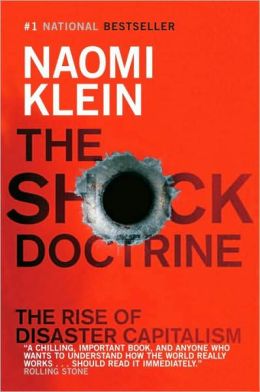
Klein makes the book's purpose clear in this early paragraph:
"This book is a challenge to the central and most cherished claim in the official story - that the triumph of deregulated capitalism has been born of freedom, that unfettered free markets go hand in hand with democracy. Instead, I will show that this fundamentalist form of capitalism has consistently been midwifed by the most brutal forms of coercion, inflicted on the collective body politic as well as on countless individual bodies. The history of the contemporary free market - better understood as the rise of corporatism - was written in shocks." (p. 18)There it is. Game over. Klein wins. She really pulls this off and the product is freaking stunning. I'm in shock and I could probably be swindled into making some bad life decisions after just reading this book. Just kidding. But it is a must read for history buffs, political junkies and economy watchers. My friend says she continues to refer to The Shock Doctrine even though it was published in 2007. The accuracy of Klein's pondering is eerie.
The Shock Doctrine is not for the weak of heart. It gives you (and hope in humanity) a swift kick to the throat over and over through recent histories backed up with painfully sound evidence. It'd be great if it was all exaggerated, but you can't make this stuff up. After one emerges from the gloom created by the reading of this book, the last ten or so pages wraps it up with hope. With all the delivery of doom, Klein does a tremendous job of putting things into perspective and actually inspiring hope in humanity. It was another brick in my belief Detroit can rise from the shock it has been in, you know, since the late sixties.
There are two particularly evil characters in this book: Milton Friedman and the Chicago School of Economics. Klein described Friedman is as the guru of unfettered capitalism. He is cast as the super villain and for good reason. He's the guy that sparked the idea of shocking a country's economy through privatization, deregulation, hollow government and completely free enterprise. Although, I am not a fan of this, I'm wondering what it will take to get Detroit back on the right path. Perhaps not a shock, but a damn wake up call is needed in Detroit government. I digress.
The other character, which spawns a slew of others throughout the book, is Friedman's homebase: the Chicago School of Economics. There only the finest crooks were molded, from leaders of junta governments to (dangerous) jokers like Donald Rumsfield. Milton and the "Chicago School" were on a crusade to spread free-wheeling capitalism and cloaked it with the word "democracy." Basically, they wanted to bank off other people's money. They did, but it is interesting to hear about their fall from grace. I'm fascinated by their failures.
Klein's perspective is brilliant. She makes many relevant connections, historical observations and she even nailed a few predictions, like how this system was going to fall apart. There's only so much people will take and only so much money you can bag before someone starts wondering where the hell it all went. Though packed tight with information, it could be read again and again and you'd learn something new each time. Klein's writing is clear and the prose pieces together a history lesson with a call to grassroots. Good stuff.
The journey that Klein takes you on in the Shock Doctrine starts in South America's Southern Cone - in Chili, Argentina and Uruguay. There's some mentions of Colombia, Bolivia and Brazil as well. Chili was Friedman's first shock experiment and there's all kinds of info on the kind of crazy stuff that went on - torture, misery villages, disapperings and American-backed coups. Not cool.
Then we are shown examples ALL OVER THE FREAKING WORLD. Seriously: China, Russia, Poland, South Africa, Lebanon, Sri Lanka, Iraq, and, of course, the United States itself. I probably missed a few. What a ride.
It was a little strange to be reading The Shock Doctrine now when it was published in 2007. Though Klein manages to let the facts speak loudly for themselves, one can tell that she is reeling throughout the book about the Bush Administration. The connections between the Administration and multinationals that have sucked the life out of the United States and the world economies are appalling. I'll just leave it at that, but that junk is well documented.
And here are a few notes that I took. I had to really restrain myself from taking too many because it would have taken me two years to finish this thing. Anyway:
"The shift has been starkest in the U.S. where CEOs made 43 times what the average worker earned in 1980, when Reagan kicked off the Friedmanite crusade. By 2005, CEOs earned 411 times as much." (p. 444)Talking about the 400,000 or so Iraqi soldiers Paul Bremer laid off after the U.S. invaded Iraq, Marine Colonel Thomas Hammes said:
"Now you have a couple hundred thousand people who are armed - because they took their weapons home with them - who know how to use the weapons, who have no future, who have a reason to be angry at you." (p. 352)A quick explanation of what shock is. It's an underlying theme throughout the work:
"A state of shock, by definition, is a moment when there is a gap between fast-moving events and the information that exists to explain them."She goes on:
"...in North America, the September 11 attacks were, at first, pure event, raw reality, unprocessed by story, narrative or anything that could bridge the gap between reality and understanding." (p. 458)Finally, this was an interesting point on Hezbollah:
"There is no question that Hezbollah is engaged in politics as well as charity, and that Iranian funds made Hezbollah's generosity possible. Equally important to its efficiency, however was Hezbollah's status as local, indigenous organization, one that rose up from the neighborhoods being rebuilt." (p. 462)There so much more great information in this book. Highly recommended for everyone.
Labels:
Books,
Business,
Capitalism,
Economy,
History,
Iraq,
Milton Friedman,
Natural Disasters,
Politics,
Terrorism,
Tsunami,
War
No comments:

7/3/08
LinkedIn: My Take
 On the long passed recommendation of T-Bone, I finally joined LinkedIn, whose mission is "to help you be more effective in your daily work and open doors to opportunities using the professional relationships you already have." I was ashamed it took this long, but after a week of using it, I'm not completely convinced I was missing out on anything particularly critical.
My connections list is not a bad piece of work, but I have had trouble adding some of my most important contacts; some of my past clients have told me that this site is blocked by their work. Another thing I kind of don't like - no, wait - hate is this email connection business. If I wanted to just email these people I would use my friggin' email. That's why I want them to get the message on LinkedIn, not in their email box.
Finally, I have already talked to a couple of people that are having trouble recommending me (insert "you suck" jokes here). I have asked them and they have had trouble with the link and the website keeps dropping errors on them. That's nice: I'm trying to get recommendations and it's only frustrating the people that I'm asking. That's real nice. Hence, the "social" part of this website is awkward and not fantastically user-friendly, at least not for me and my peeps just yet.
Of course, I scoured the Internet to see what others are saying and it's a mixed bag. Some people love it. Some people think it's lame and boring. Some find incredible opportunities with it and others are just on it to show up. Right now, I'm just using it as an online resume, mainly because I'm a bit to lazy to put one together myself. Check out my public LinkedIn site at http://www.linkedin.com/in/evagro.
Here's some additional reading you might want to check out about LinkedIn:
- The LinkedIn Conundrum - an interesting piece about some legalities and sticky situations; quite possibly the reason some of my clients can't access all areas of LinkedIn.
- Nielsen: MySpace, Club Penguin growth static, LinkedIn soaring
- LinkedIn is *NOT* Facebook for Grownups - nice comparison between the two by the Free Range Librarian. Good comments, also.
- LinkedIn vs. Facebook, 6 Months Later
- 100+ Smart Ways to Use LinkedIn - lots of interesting ways to make LinkedIn work for you. I should probably take a closer look myself.
- Are you LinkedIn?
- Study: men more likely to use social networking for business
6/25/08
Today's Knowledge: You know you're stinkin', friggin' rich when...
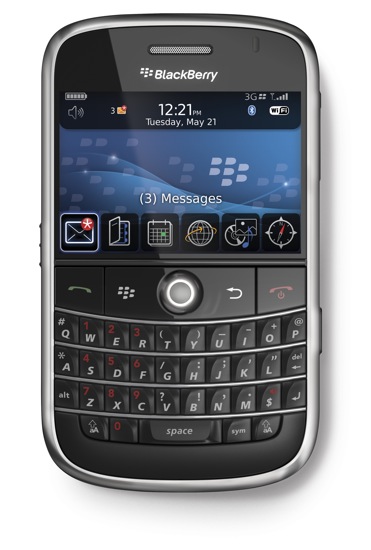 ...you are a Research In Motion (RIM) investor. The BlackBerry has made them a mountain of money, grew their shares' worth and has dominated the business consumer market. The BlackBerry Bold is already getting some righteous reviews. And, frankly, nobody even flinched at RIM when the new iPhone came out. RIM barely missed the revenue expectations, but the investors were pissed when they heard their profits had to wait because RIM is thinking long term. The investors decided to rain on RIM's parade on Wall Street. Thing is, what I've been reading for the passed day has indicated that there is room for both iPhone and BlackBerry in the market. (My vote: clearly the BlackBerry.)
Extra Readin':
6/18/08
Podcast about Jim Kramer, Mr. Mad Money himself
Check out this podcast: "Booyah!"
This is a great 12-minute podcast about Mad Money's Jim Kramer. I really enjoyed learning more about him. He has a fascinating background and this is a very smart man. Plus, I really love the perfectly placed Mad Money sound bites ("Sell, sell, sell" and of course, "Booyah!"). It's well produced. Enjoy.
This is a great 12-minute podcast about Mad Money's Jim Kramer. I really enjoyed learning more about him. He has a fascinating background and this is a very smart man. Plus, I really love the perfectly placed Mad Money sound bites ("Sell, sell, sell" and of course, "Booyah!"). It's well produced. Enjoy.
6/7/08
"Stimulus may be working" - Oh, really? On what planet?
Cranky Pants Warning: I am working at the library right now and it's 86 degrees inside. Our air conditioning is broken and I am not amused. Not cool. Literally, not cool, man. Hence the heat has made my mood foul. This blog is a product of that foul mood. My apologies in advance.
My Google Reader was jam packed today with over a thousand news bits and Internet treats for my review. I foolishly decided to look through the past few days of business news. Wow, what a total bummer.
First, a Wall Street Journal article basically wrapped up the terrible economic climate here in the United States:
In the investing world, securities ratings practice will hopefully be getting a makeover. This is very necessary as investors were buying securities under false pretenses. Here's a snippet from an article entitled Bond-rating agencies agree to reforms:
And finally, while we sit here and struggle, it's interesting to hear what world leaders think. For example Russian President Dmitry Medvedev criticized the U.S. for being economically egotistical. He says Russia has the answer for the mess that the U.S. has created. Shoot, at this point, I think we should accept assistance and advice from any place we can get!
Our fearless leader, however, is sort of on another planet. While plowing through all these articles predicting the wrath of economic crisis, I found that the president thinks that his stimulus package "might" be working. Well, isn't that just swell? From article 'Stimulus may be working' - Bush:
My Google Reader was jam packed today with over a thousand news bits and Internet treats for my review. I foolishly decided to look through the past few days of business news. Wow, what a total bummer.
First, a Wall Street Journal article basically wrapped up the terrible economic climate here in the United States:
Unemployment rose sharply and payrolls shrank for the fifth consecutive month. The economy news came on a day that oil surged to record prices, the dollar weakened and the Dow Jones Industrial Average plunged nearly 400 points. The deteriorating job numbers led markets to scale back the odds that the Federal Reserve will boost short-term interest rates this fall to ward off inflation.From this article, I also learned a new term - "misery index." This is the sum of the unemployment and inflation rates. The index is at the highest level since the early 1990s. There are many more gloomy details in the article, however, there was one, tiny bit of positive news:
The next article I read was called Consumer debt jumps $8.9 billion. While analysts knew that the amount of consumer debt would rise, they didn't expect it to be so bad. They expected the debt to rise by $7 billion when in actuality it rose by $8.9 billion. I discovered another term: "revolving credit." Revolving credit is an account on which payment is any amount less than the total balance and the remaining balance carried forward is subject to applicable finance charges. Basically, credit card debt is revolving credit. Fixed payments - student and car loans - sharply increased, making up $8.7 million of the $8.9 billion consumer debt accumulated.Service-sector employment, by contrast, gained 8,000 jobs last month. That reflects continued strength in education, health services and hospitality industries, offsetting losses in business and professional services and retail trade.
In the investing world, securities ratings practice will hopefully be getting a makeover. This is very necessary as investors were buying securities under false pretenses. Here's a snippet from an article entitled Bond-rating agencies agree to reforms:
With the old model, many investors purchased a security they believed to be safe because they had pristine AAA ratings, but in fact many of the assets were of poor quality. Critics and lawmakers have long argued that the rating industry did not adequately warn investors about the risks involved with mortgage investments.As you can imagine, this blog doesn't get any happier at any point. There's just too much bad stuff happening in the economy. It's rather strange that people are still hesitant to call this a recession when it clearly is. For example, if we weren't in a recession, why would Americans be $1.7 TRILLION dollars poorer or barely surviving on credit cards?
And finally, while we sit here and struggle, it's interesting to hear what world leaders think. For example Russian President Dmitry Medvedev criticized the U.S. for being economically egotistical. He says Russia has the answer for the mess that the U.S. has created. Shoot, at this point, I think we should accept assistance and advice from any place we can get!
Our fearless leader, however, is sort of on another planet. While plowing through all these articles predicting the wrath of economic crisis, I found that the president thinks that his stimulus package "might" be working. Well, isn't that just swell? From article 'Stimulus may be working' - Bush:
The government's $168 billion stimulus package, passed in February, began getting tax rebate checks to people last month and helped to energize shoppers. "We're beginning to see signs that the stimulus may be working," Bush said at the Department of Housing and Urban Development.
OK, so did anyone let the president know that Americans are $1.7 TRILLION dollars poorer? Does he not see that his little, bitty $168 billion stimulus package isn't going to be used for SHOPPING!? It's going to be used to SURVIVE: to buy food and gas, to pay the mortgage or rent - not to go on a shopping spree. So out of touch, this guy.
Feel free to read more about all this stuff. Here's the articles I read through:
- Recession Fears Reignited (WSJ)
- Consumer debt jumps $8.9 billion (CNNMoney.com)
- Corporate America is getting nervous (CNNMoney.com)
- Bond-rating agencies agree to reforms (CNNMoney.com)
- Americans $1.7 trillion poorer (CNNMoney.com)
- Barely surviving on credit cards (CNNMoney.com)
- Russian president blasts U.S. 'economic egotism' (CNNMoney.com)
- 'Stimulus may be working' - Bush (CNNMoney.com)
4/10/08
Economy explained in about 40 minutes
This April 3rd Fresh Air episode is an interview with Michael Greenberger. He does an excellent job explaining what is happening to the United States as it wades through this economic mess. Highly recommended.
read more | digg story
read more | digg story
3/28/08
Apple Retools iPhone for Business Users
Recent announcements indicate that Apple will reposition the iPhone for business use, competing with Research-in-Motion's popular BlackBerry smart phone. In addition, an iFund of $100 million in venture capital will encourage development of business applications for the devices. Of interest to information management stakeholders is the device's potential as another repository of e-mail, calendars, and records.
Read MORE.
Read MORE.
3/12/08
Podcasts: Business, Housing, Politics, Corporate Thievery
I was listening to a few podcasts today and thought I'd share some little bits and pieces I jotted down. Notice: all these podcasts rock. You should listen to them.
Moneyfile Podcast:
Trading in your old computers can get you some money while helping you preserve the environment. You want to backup all your stuff and then wipe your hard-drive. Laptops are worth more than desktops. LISTEN.
Wall Street Journal podcast:
Small business owner discusses how he keeps his business afloat in hard economic times like these: provide information seminars. Another part of this podcast talks about why the American Small Business League is angry. Bascially huge corporations are finding loopholes to count themselves as small businesses in the United States. This means that the big corporations are gobbling up Federal funds and leaving actual small businesses in the dust. For example, if a small business is bought out by a huge business, there is a stipulation that the huge business can maintain its small business status for 20 years. BAE is a huge corporation that has gets small business benefit from the U.S. Government up to $250 million dollars. This type of widespread fraud can land someone in jail for 10 years, but no one, or at least very few, have been prosecuted. The podcast works well in iTunes, but is funky otherwise, hence, read more about the American Small Business League's battle in the article SBA wants new Judge in Lawsuit Over Inflated Contracting Data.
And good news for Detroit - a study by Radar Logic says the housing slump has almost hit rock bottom, meaning the only place you can go is up. Congrats. LISTEN.
Fidelity Personal Finance podcast:
This was a great podcast that discussed avoiding all kinds of fees: from late credit card payments to ATM withdrawls, etc. The podcast was called, "Avoiding Banking mistakes." This and a bunch of REALLY good podcasts can be heard HERE.
Meet the Press podcast:
Governor of PA offered to help raise money to have a revote in Florida and Michigan, since so many people weren't counted.
1/16/08
Vocabulary: Business, part 1
In my glorious journey through the land of business reference, I have learned many new things. In the same breath, I've developed many more questions, especially when it comes to business vocabulary. I noticed that there were a number of words I didn't understand when listening to the Wall Street Journal podcasts. So I made a list of words I often hear. I'm offering a definition and an article about each term, for myself and for you.
consumption smoothing - basically what I found on this was two things: huge research papers and random comments by folks. On Assetbuilder.com, a guy named Scott wrote that, "[Consumption Smoothing] is the idea that we all try to “smooth” our consumption over our lifetime, extracting the maximum utility. It means that we don’t squander our youth to benefit our old age, or squander our money when young to impoverish our old age." It's a good, concise post and I recommend reading it.
Article: Receiving fire at the front line: Consumption smoothing is a novel idea, not hucksterism
windfall profit/gain - An unexpected profit arising from causes not controlled by the recipient
Article: Standard Life conjures up £100m in annuity windfall
portfolio - a list of the financial assets held by an individual or a bank or other financial institution
Article: Gold may glitter, but in a slowdown focus on your portfolio instead
subprime mortgage - the practice of making loans to borrowers who do not qualify for the best market interest rates because of their deficient credit history
Article: You could probably find a trillion articles on this very relevant topic, but here's one to get you started...Student loans stung by subprime mortgage crisis
Subscribe to:
Posts (Atom)