 Just finished watching this documentary and I'm kind of freaked out people aren't talking about it more. This is one of the biggest elections ever. It's definitely the biggest in my lifetime. It basically shows how the memory chips that store vote counts are vulnerable to hacks, because they have an executable file on them (even though the maker, Diebold, denied there was an .exe file). The creators of the film did a great job, but I really liked hearing Bev Harris' story the most. She was so diligent and uncovered such important information just by being super curious. Great documentary.
3/31/08
Hacking Democracy
Just finished watching this documentary and I'm kind of freaked out people aren't talking about it more. This is one of the biggest elections ever. It's definitely the biggest in my lifetime. It basically shows how the memory chips that store vote counts are vulnerable to hacks, because they have an executable file on them (even though the maker, Diebold, denied there was an .exe file). The creators of the film did a great job, but I really liked hearing Bev Harris' story the most. She was so diligent and uncovered such important information just by being super curious. Great documentary.

3/28/08
Book Review: Fat Land
 Fat Land, by Greg Critser
This book is the author's attempt at explaining how Americans became the fattest people in the world. This is one of the best non-fiction books I've read in a long time. In this review, I go chapter to chapter with my own notes. These notes, although pretty thorough, give the book no justice, because it's just that good. I like how he takes a very long look at the history of obesity, exercise, food and other related issues of this country. Highly recommended.
Some general comments on the book:
- It's short - without index and additional material, it's only 176 pages.
- Fast read - it's so well written, that even medical mumbo jumbo is really interesting, shocking and REAL.
- Knowledge, knowledge, knowledge - plenty of information on history, social class, race, health, biology, research, habits of children, etc.
- Sound journalism - from what I can tell, anyway. Great notes (with additional comments on each chapter), sources, quotes, and observations.
- Book focuses mainly on California and Texas. I wonder about if kids in colder parts of the country have a harder time getting out more in frigid weather. Does it matter at all?
- I liked the idea of "European-sized" foods because it provides an amusing visual when put next to our "Super-sized foods".
- Great closing with a Dante mention. So good.
Chapter by Chapter Notes
Ch 1
Critser argued that globalization in form of free trade created cheap and abundant food supply in 1970s, starting with Malaysia and its palm oil. Palm oil was the high fructose corn syrup of the fat world. Its chemical makeup is closer to that of beef tallow than vegetable oil and its fat is more saturated than pork lard. The reason this was all important was because with palm oil, stuff could be made way cheaper - which people liked. It didn't break down easily at all, but that didn't seem to be a problem in that era.
Ch 2
Before mega-huge movie popcorn, there were actually NORMAL sized ones. It's true. Critser talked about how people didn't want to be the fatso buying 2 popcorns (or french fries, etc) back then. It was almost like the shame of holding two popcorns, indicating you're gorging on popcorn, was like a check and balance for people to control themselves. One of the hugest marketing wonders was to make ONE popcorn bigger and tricking the consumer into thinking they're getting more for less, minus shame of two containers. I know, pretty absurd. This chapter also focused on the decrease of family dinners due to allegedly people's lives getting busier and the increase of constant snacking as a daily routine.
p. 28 Fun fact - A serving of McDonald's fries went from 200 calories (1960) to 320 calories (late 70s) to 450 calories (mid 90s) to 540 calories (late 90s) to the present day total: 610 calories.
Ch 3
Ch 3
All about kids' nutrition: how school fund cuts leads to nasty/cheap food production. Cuts in Los Angeles school district made the school turn to Pizza Hut for their lunches. In 1977 Americans got 18% of their calories away from home. In 1994 it was 34% calories away from home. USDA: "We calculate that if food away from home had the same nutritional densities as food at home . . . Americans would have consumed 197 fewer calories per day." That equals about an extra pound worth of energy every 20 days.
First the parents let the kids down with not helping them develop good eating habits and then the public schools follow suit. Great.
Ch 4
This chapter is where we witness Physical Education's doom. In California there have been PE requirements since the 19th century. It's where physical fitness used to be king, in and outside of school. This starts changing in the 1970s. There was a fitness boom, but people were focused on the individual and medical purposes instead of group participation and peak performance.
Critser says that baby boomers with bad memories from their old gym days (i.e. being last to be picked) would later help crush PE, because they didn't want to expose their child to that type of PE experience. But the baby boomers accepted private fitness solutions for their kids (i.e. travel leagues) where everyone plays. By the 1990s, the author said, the message was clear: "In America, fitness was to be purchased even if you were a child."
There's discussion of how various organizations, including Center for Disease Control kept lowering the standards for the exercise prescription, meaning they were under mining the importance of vigorous exercise. The standard basically went from "adequate exercise means vigorous exercise" to "take the stairs instead of the elevator". Basically, CDC and others exaggerated that moderate exercise was good enough and that vigorous exercise didn't help that much. And the science was far from sound.
p. 94 Dose response effect. Williams of Lawrence Berkeley National Laboratory. In a 1993 study of 8,283 male recreational runners he said, "Our data suggest that substantial health benefits occur at exercise levels that exceed current minimum guidelines and do not exhibit a point of diminishing return." 2001 American College of Sports Medicine findings note that dose-response relationship holds true for prevention of type 2 diabetes, colon cancer and obesity.
p. 114 By 1993 41% of Saturday morning ads that accompanied cartoons were for high fat food.
Ch 5
Author talks about how tweens are fatter, about how poverty, race, class can increase/decrease chance of obesity. Anorexia is found in wealthier white teens, while black teens feel more comfortable with themselves even though they're generally more overweight.
p. 125 Insurance companies pay for anorexia prescription for adolescents but won't cover effective obesity drugs for kids. Not that kids in the hood have insurance to begin with, but still...
p. 126
The last phrase in chapter 5: Diabetes - the growth industry for an ever expanding nation.
Ch 6
Thrifty gene theory. Groop said "The insulin-resistance gene has protected individuals during long periods of starving by storing energy as fat rather than as glycogen in muscle. The abundance of food in Western society has made this once protective gene a deleterious one, suggesting that these individuals are not equipped with the metabolic machinery to handle overeating."
Utero programming holds that pregnant women that face starvation during term are more likely to have child metabolically disposed to retain fat.
There's lots of science in chapter 6. Sometimes a little tough to follow, but generally pretty clear. Talks about genes, enzymes, fructose, metabolic breakdowns, artery walls, gallstones, and of course diabetes - which I never realized quite how awful it is. Talks about every part of the body effected by obesity: skeletal system, blood stream, pancreas, brain, feet, etc.
Chapter 6 ends with a hypothetical situation where most people fall into the categories of obese and not so obese. Talks about the woes of every day life for fat families.
Ch 7
Talks about San Antonio school district and Dr. Robert Trevino's aggressive and unconventional tactics that in the end helped the elementary kids get better.
p. 155 - A great story about PE teacher from West Middle School in Downey, CA. He came up with a video game health club which became VERY popular.
Author also emphasized the point that soda pop companies contribute not only millions of dollars, but millions of calories in exchange. No doubt kids' pop consumption has a lot to do with their increasing obesity numbers.
Apple Retools iPhone for Business Users
Recent announcements indicate that Apple will reposition the iPhone for business use, competing with Research-in-Motion's popular BlackBerry smart phone. In addition, an iFund of $100 million in venture capital will encourage development of business applications for the devices. Of interest to information management stakeholders is the device's potential as another repository of e-mail, calendars, and records.
Read MORE.
Read MORE.
3/27/08
Tee-hee, tee-hee
I try to keep this blog neutral and relatively controversy free, but as the current president of the United States provides endless fodder for humor, I thought I'd pass this lil' contest along. The contestants got to draw what they envision Dubya's Presidential Library to be. Some of the designs are serious, but the good ones are hilarious.
My favorite is definitely the one with an oil line from Iraq and the Statue of Liberty flipping the bird in either direction - priceless.
View them all at: http://chronicle.com/free/v54/i26/26b01401.htm#7
My favorite is definitely the one with an oil line from Iraq and the Statue of Liberty flipping the bird in either direction - priceless.
View them all at: http://chronicle.com/free/v54/i26/26b01401.htm#7
A Very Optimistic Outlook
I really can't say that I believe all this will happen, but I hope I'm wrong and this guy is right:
Sure, the US economy is struggling, but it should start looking up by late 2008 and 2009, say U-M economists. In their annual spring forecast update, Saul Hymans, U-M professor emeritus of economics, and colleagues Joan Crary and Janet Wolfe, predict 2.5 percent growth in the GDP during the second half of 2008, followed by an even stronger 2.9 percent gain in real GDP in 2009. Light vehicle sales will stabilize, housing starts will pick up by 30 percent after bottoming out, and the price of oil will drop from the current $110 per barrel to an average of $88. Core inflation should remain in check at about 2.5 percent this year and next, and consumer spending should stabilize at a lower but not disastrous rate of 2 percent growth.
3/26/08
My Money Blog: Pet Insurance
I was just doing some virtual spring cleaning. Looking through my list of blogs, I found some had to go and others were long-forgotten gems. My favorite gem today was My Money Blog. I just read a really great post on pet insurance.
 Pets are very dear to me. My parents and I spent over $2,000 on a surgery to remove a tumor from my dog's head (pictured). Even in dire economic conditions like this, I still think we would've paid for it. Just look at her...
 Pets are very dear to me. My parents and I spent over $2,000 on a surgery to remove a tumor from my dog's head (pictured). Even in dire economic conditions like this, I still think we would've paid for it. Just look at her...

3/16/08
World Bank, India to Probe 5 Health Projects
I just watched Fog of War: Eleven Lessons from the Life of Robert S. McNamara. It was a pretty darn good documentary, even if it was slow a couple times. I found myself really feeling for this man in his late eighties who oversaw all kinds of human destruction. It was actually quite revealing, at least to me. Also, a must-watch for people interested in history as it relates to war.
I never really realized that he was head of the World Bank from April 1968 to June 1981 and thought it a strange coincidence that right after I watched the film I found this on the Washington Post's home page:
These investigations are about project that date back to 1997, well after McNamara was out. Just a random connection, I suppose.
I never really realized that he was head of the World Bank from April 1968 to June 1981 and thought it a strange coincidence that right after I watched the film I found this on the Washington Post's home page:
The World Bank and the Indian government have launched official investigations in response to an internal bank report that found 'serious' incidents of fraud and corruption in five bank-financed health projects in India.
read more digg story
These investigations are about project that date back to 1997, well after McNamara was out. Just a random connection, I suppose.
Police: Put bad kids on DNA list to target future offenders
This is wrong on so many levels...School children as young a five years old should be eligible for the DNA database if they exhibit behaviour indicating they may become criminals in later life, said a senior Scotland Yard expert. Civil liberty groups condemned his comments last night by likening them to an excerpt from a 'science fiction novel'.
read more | digg story
read more | digg story
3/13/08
100 Ways to Use Your iPod to Learn and Study Better
If you think that iPods are used just for listening to music, you obviously haven't been keeping up with the latest technology. To find out about the many different ways you can transform your iPod into a learning device, check out our list below.
read more digg story
read more digg story
3/12/08
Podcasts: Business, Housing, Politics, Corporate Thievery
I was listening to a few podcasts today and thought I'd share some little bits and pieces I jotted down. Notice: all these podcasts rock. You should listen to them.
Moneyfile Podcast:
Trading in your old computers can get you some money while helping you preserve the environment. You want to backup all your stuff and then wipe your hard-drive. Laptops are worth more than desktops. LISTEN.
Wall Street Journal podcast:
Small business owner discusses how he keeps his business afloat in hard economic times like these: provide information seminars. Another part of this podcast talks about why the American Small Business League is angry. Bascially huge corporations are finding loopholes to count themselves as small businesses in the United States. This means that the big corporations are gobbling up Federal funds and leaving actual small businesses in the dust. For example, if a small business is bought out by a huge business, there is a stipulation that the huge business can maintain its small business status for 20 years. BAE is a huge corporation that has gets small business benefit from the U.S. Government up to $250 million dollars. This type of widespread fraud can land someone in jail for 10 years, but no one, or at least very few, have been prosecuted. The podcast works well in iTunes, but is funky otherwise, hence, read more about the American Small Business League's battle in the article SBA wants new Judge in Lawsuit Over Inflated Contracting Data.
And good news for Detroit - a study by Radar Logic says the housing slump has almost hit rock bottom, meaning the only place you can go is up. Congrats. LISTEN.
Fidelity Personal Finance podcast:
This was a great podcast that discussed avoiding all kinds of fees: from late credit card payments to ATM withdrawls, etc. The podcast was called, "Avoiding Banking mistakes." This and a bunch of REALLY good podcasts can be heard HERE.
Meet the Press podcast:
Governor of PA offered to help raise money to have a revote in Florida and Michigan, since so many people weren't counted.

Moneyfile Podcast:
Trading in your old computers can get you some money while helping you preserve the environment. You want to backup all your stuff and then wipe your hard-drive. Laptops are worth more than desktops. LISTEN.
Wall Street Journal podcast:
Small business owner discusses how he keeps his business afloat in hard economic times like these: provide information seminars. Another part of this podcast talks about why the American Small Business League is angry. Bascially huge corporations are finding loopholes to count themselves as small businesses in the United States. This means that the big corporations are gobbling up Federal funds and leaving actual small businesses in the dust. For example, if a small business is bought out by a huge business, there is a stipulation that the huge business can maintain its small business status for 20 years. BAE is a huge corporation that has gets small business benefit from the U.S. Government up to $250 million dollars. This type of widespread fraud can land someone in jail for 10 years, but no one, or at least very few, have been prosecuted. The podcast works well in iTunes, but is funky otherwise, hence, read more about the American Small Business League's battle in the article SBA wants new Judge in Lawsuit Over Inflated Contracting Data.
And good news for Detroit - a study by Radar Logic says the housing slump has almost hit rock bottom, meaning the only place you can go is up. Congrats. LISTEN.
Fidelity Personal Finance podcast:
This was a great podcast that discussed avoiding all kinds of fees: from late credit card payments to ATM withdrawls, etc. The podcast was called, "Avoiding Banking mistakes." This and a bunch of REALLY good podcasts can be heard HERE.
Meet the Press podcast:
Governor of PA offered to help raise money to have a revote in Florida and Michigan, since so many people weren't counted.
3/11/08
Quick Yoga Tips: Relax or Energize
After putting together a New Years Resolutions display at the library, I came upon this book that made me kind of laugh. It was called: Yoga Secrets for Business Success by Arshan Singh Khalsa. For the time that it spent on the display, no one ever looked at it. I was changing the display (to Mafia and True Crime :) and in the end, I was the patron who checked it out. Strangely enough I found some interesting stuff, but the next two tips were the coolest. I haven't tried them, but the damn book is due and I've renewed it like a million times. Hence, this will be my little place to look back for a reference. Let me know if either technique works for you. I might recommend checking the book out also. It's got a lot of interesting stuff to help you get through the day.
Click on this lil' picture to RELAX: | Click on this lil' picture to ENERGIZE: |
3/10/08
Book Review: The Last Book in the Universe
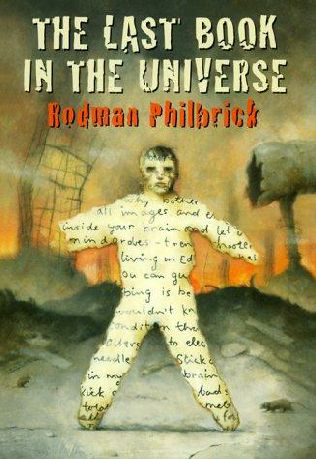 Last Book in the Universe, by Indman Philbrick
There were two reasons I picked up this book. One was because I read a positive review someplace. The other was because I sensed that it could have a similar feel, perhaps a younger feel, of Fahrenheit 451 (a.k.a. "Best Book Ever"). In the end, the book managed an "OK" rating by me.
The Last Book in the Universe, by Rodman Philbrick, is the first youth book I've picked up in probably over a decade. I suffered through the first half and it gradually got better, and then pretty good, after the halfway mark.
It's about a kid who lives in a world after a massive earthquake that separates the world into the Urb (where everyone is "normal" and wretched) and Eden (where humans are genetically perfect and grass actually grows).
Spaz is a kid living in the Urb who meets, Ryter. He's, well, uh, a writer. Clever? No, not really. Some of my favorite parts were about writers, so that's forgiven. Spaz once lived with a family and was banished from the household because he had seizures. He gets a message from his sister, Bean, that she's ill and wants to see him. He narrates his journey.
Like I said, it's ok, but here's my favorite snippets.
p. 194:
p. 209"How come you're always talking about being old?" Bean wants to know.
"I don't mind the 'old' part. I'm just worried I won't have enough time to finish my book."
Bean nods wisely, as if she expected that particular answer. "But would it ever really be finished?" she asks. "I thought the book was your life, and it would only end when your life ends. Except it won't really end, because people will read it and remember, so in a way, you'll live forever."
At first I think he's offended, but after a while a smile slowly creases his aged face. Thank you, Bean," he says, and pats her hand.
"For what?"
"For reminding me of why I'm a writer."
Yep, that second one is amazing, right?[Ryter says:] "What's to write about if life is perfect? If you spend all of your time lazing about and dangling your old feet in cool streams of clean water? Writers need a challenge. They need to struggle. They need to fight."
Nutrition Data
Recently I've been trying to watch what I eat. My plan is to eat healthy throughout the week and then put the hurt on the yummy stuff on the weekend (i.e. beer, barbeque, taco bell). So far, it hasn't been too bad, although eating like a rabbit gets old, quick.
I wanted to know more about the food I'm eating and revisited Nutritiondata.com. This has all types of information to put together the kind of diet that suits you, from calorie counts to fullness levels. After you get beyond all the little graphs, the site offers a little synopsis about the food, basically the good and the bad. Finally, at the bottom you'll find more about the food you eat than you've ever wanted to: fat per serving (with many serving amounts), vitamin levels, minerals and other stuff.

3/7/08
Bill to Promote Health Information Technology Introduced
February 14, representatives introduced H.R. 5442, the Technologies for Restoring Users’ Security and Trust in Health Information Act (TRUST). The legislation is intended to promote the use of information technology within the healthcare system while protecting privacy and security of personal medical information.
URC investing in 'revolutionary but feasible' energy ideas
Michigan's University Research Corridor is investing up to $900,000 of its own resources in seed grants to speed the development of "revolutionary but feasible" alternative energy research. The URC, an alliance of U-M, Michigan State University and Wayne State University, will consider faculty proposals related to novel research in energy policy, materials (including nanomaterials), clean energy sources, transmission and storage of materials that is environmentally safe, cost-effective and secure. A panel of experts from the three universities will select grant recipients, giving preference to projects that show the best potential for feasibility and impact. The universities hope the seed funding will attract further interest from industry, government and foundations.
3/6/08
Water Lines Remain Shattered in New Orleans
I heard this podcast the other day and it was a very good, but very grim, story about New Orleans. Although everyone's toilets are flushing and showers are working, experts estimate that the damaged water lines leak around 50 MILLION gallons of water a day, which amounts to about 95 Olympic-sized swimming pools full. I wondered to myself how desperately needed clean water was in many places around the world. Then I thought, heck, I'm sure they'll need it in the Big Easy, too. But there it is gushing out into nowhere, for no one to have.
Hear the entire news report at:
http://www.npr.org/templates/story/story.php?storyId=87877841#share
Hear the entire news report at:
http://www.npr.org/templates/story/story.php?storyId=87877841#share
3/4/08
Book Review: Dawn

This story takes place right after World War II in British controlled Palestine. The Jews are terrorists in this and both sides are killing hostage for hostage. Religion plays major role in this violence, no surprise there. This is a very familiar story and although some of the sides are switched around, it remains timeless. It is incredible to see Israel act as it has when they, too, were once in the same position as the Palestinians.
The story's narrator and main character is Elisha, who is a tender 18 years of age. He was in a concentration camp, was a mess after liberation and was then discovered by Gad who brought him into the world of terrorism as the world tried to figure out where to relocate the liberated Jews. Now, he is waiting for dawn to kill a captured English soldier named Dawson. This is the Jewish response to one of their captured freedom fighters who was put to death. An eye for an eye, I suppose.
Although Elisha claims that he saw God die many times at the concentration camp, he remains faithful, if not merely fearful. He talks about how it is believed that beggars can sometimes be the prophet Elijah in disguise and that the prophet is ready to reward men who care for him. In another part of the book he says that from time to time God showed himself in the face of a child. Throughout the night he sees a variety of people in his life, a beggar, a child, his parents. All of them feel sorry for him, but they are all there with him in the end. A great quote that summed this up was this one: "An act so absolute as that of killing involves not only the killer but, as well, those who have formed him."
As always, Wiesel writes in very clear and powerful prose. No B.S. No flowery fiction, pretty princess prose. Just a swift punch to the gut. The book is short and to the point. In the end the man that is to be executed by Elisha tells him he feels sorry for him. It is ironic that the man facing DEATH feels sorry for Elisha, his executioner. Pity is a very common theme that sprouts up. As is guilt, which is a very Wiesel-esque theme.
It is interesting to hear how Elisha looks to try to hate, saying that his people were murdered in concentration camps because they were incapable of hating. Elisha tries to redirect his hate for Dawson (which doesn't exist), blaming him for making him a murderer. Then, when that idea bombs, he tries to turn to propaganda and pride to help him hate. Finally, his last attempt has him thinking about David, the man hung by the British. But David is a man he's never met and that plan for hate also fails.
A good book, but I'm biased cause Wiesel is one of my favorite authors. There is just one more quote that I thought was worthy to post: "The silence of two people is deeper than the silence of one."
Indeed. And the silence of many is that much deeper. Remember that when you're voting.
3/3/08
Luddite Artists
I heard an NPR podcast about a bunch of artists getting their lil' panties in a bunch because Polaroid, which has already stopped making instant cameras, will now stop making the film as well. It was really sad listening to these Luddites blather how "the young artists will never get to experience this..." and other similar comments. Fact of the matter is that when technology gets better, the old technology becomes obsolete. I understand that is very enticing for the artsy-fartsy types, but come on now! Reality check, please!
I tell you what, as a writer, I could give two [insert plural form of expletive here] about old press techniques. Although sort of interesting in a dorky way, I'm NEVER going to long for the days of papyrus or the Gutenberg press. Hell, I'm glad that we don't have to deal with those mimeograph machines any more. Hell, I won't purchase a PHONE if it doesn't have a typing pad.
I've always been fascinated with the Diffusion of Innovations and why artists are ALWAYS on the stubborn, "I-don't-need-no-stinkin'-technology" part of the curve. Grow up. Make you're art better, cause after all, doesn't art imitate life? Being the efficiency freak that I am, it always makes me wonder why people make their best effort to keep something the way it is, especially if it slows down any process, creative or otherwise.
You can listen to the NPR Podcast at:
http://www.npr.org/templates/story/story.php?storyId=19344432
I tell you what, as a writer, I could give two [insert plural form of expletive here] about old press techniques. Although sort of interesting in a dorky way, I'm NEVER going to long for the days of papyrus or the Gutenberg press. Hell, I'm glad that we don't have to deal with those mimeograph machines any more. Hell, I won't purchase a PHONE if it doesn't have a typing pad.
I've always been fascinated with the Diffusion of Innovations and why artists are ALWAYS on the stubborn, "I-don't-need-no-stinkin'-technology" part of the curve. Grow up. Make you're art better, cause after all, doesn't art imitate life? Being the efficiency freak that I am, it always makes me wonder why people make their best effort to keep something the way it is, especially if it slows down any process, creative or otherwise.
You can listen to the NPR Podcast at:
http://www.npr.org/templates/story/story.php?storyId=19344432
Subscribe to:
Posts (Atom)