- Finding work when you don’t have any
- Promoting yourself even if you’re shy
- Writing when you don’t feel inspired or energetic
- Staying productive despite a hundred minor distractions
- Completing assignments on time even when you have a good excuse not to
- Taking assignments that aren’t interesting
- Finding ways to improve as a writer
- Learning, learning, learning
5/31/08
Got what it takes to freelance?
John Hewitt wrote a post called "Are You Determined Enough to be a Freelance Writer?" He discusses how freelancing takes some serious determination and constant hard work. With a healthy amount of determination, one can work through stuff like this:

5/30/08
Poetry as the paint for life's portrait
I haven't exactly been writing tons of poetry, but I have been reading a lot of it. The other day, my good buddy T-Bone had this as her Google handle:
When I read this handle, another wave of inspiration and understanding filled my feeble mind. It is so true, so beautiful and so vastly insightful. It reminded me why reading and writing poetry is so important and not merely an artsy fartsy waste of time. With this passage in mind, I read the poem entitled "The Translucent Stone." Admittedly, I didn't really like this poem, but I did appreciate it for doing exactly what the passage above described: it helped the poet inhabit his earth. It then helped me to view a plain old rock as an enchanting stone.
I am indebted to Tera for bringing my attention to the glorious nature of poetry. Poetry can take the reader in so many directions, so many that two readers can read the same poem and have definitely different interpretations of it. Such is life. No two people that live can interpret life the same way, but it's always so interesting to share those thoughts and differences.
"Let us remember...that in the end we go to poetry for one reason, so that we might more fully inhabit our lives and the world in which we live them, and that if we more fully inhabit these things, we will be less apt to destroy both." -Christian Wiman
When I read this handle, another wave of inspiration and understanding filled my feeble mind. It is so true, so beautiful and so vastly insightful. It reminded me why reading and writing poetry is so important and not merely an artsy fartsy waste of time. With this passage in mind, I read the poem entitled "The Translucent Stone." Admittedly, I didn't really like this poem, but I did appreciate it for doing exactly what the passage above described: it helped the poet inhabit his earth. It then helped me to view a plain old rock as an enchanting stone.
I am indebted to Tera for bringing my attention to the glorious nature of poetry. Poetry can take the reader in so many directions, so many that two readers can read the same poem and have definitely different interpretations of it. Such is life. No two people that live can interpret life the same way, but it's always so interesting to share those thoughts and differences.
5/29/08
I hate Comcast and you should, too.
Dark Days of Comcast
OK, I've really got to get this post off of my draft list. Although I have made peace with myself on this topic, the truth remains: I HATE COMCAST. I hate Comcast with the fire of a thousand suns.
First, please know that this is my personal experience, but I have heard many folks with similar experiences. None are quite as miserable. My bottom line is: do NOT expect good service from Comcast if something goes wrong. When everything is fine, as was when I lived in Dearborn, it's really great. However, the very week I moved to Southfield, my Comcast service went right into the toilet.
I should've known that something wasn't right when the two guys installing my service in Southfield were commenting to each other how weak the signal was. I asked if that's something I should worry about, but they kind of brushed me off. I would quickly get used to getting brushed off.
In the following weeks, then months, my internet service would drop DAILY. I'd be in the middle of a yoga class, trying to breath and relax and then fell victim to shoddy internet. I called about ten times and had someone come out at least five different times, and that's not including the guy that came to install the HD box.
Each time, they'd come in, see that the modem was working fine (as it always did when the techs were around) and that the signa l was strong. They told me a rewiring of my apartment might be the answer. They blamed it on my router. They blamed it on outages, which, by the way, this huge communications company can't keep track of. I was told there was an outage 3 days after the fact and only, of course, only when I called and asked. They totally ghetto-rigged my then internet and TV connection (pictured to the right). The line poking awkwardly out of my wall is my television connection, which is also questionable sometimes, but I can live with an occasional blip. I hate Comcast so much that I don't even want them to come fix this.
The Light at the End of the Tunnel: AT&T
Today, I have AT&T DSL and it's been pristine. Admittedly, you can tell that the internet is a little bit slower at first, but it gets better, you get used to it and it DOESN'T drop out. Not ever - at least not mine. I'm VERY happy with AT&T. They provide me with internet AND fantastic cell phone service (all hail the might BlackBerry).
However, I should mention what the catch is: if you have a problem, it's kind of a self-serve troubleshooting process. You call AT&T and they try to walk you through it. Everything I've dealt with has been easily worked through with the folks on the phone and online through chat. They have a call service you pay for, which I didn't need. Yet, when you need someone to come in and look at the hook up inside...you pay a $200 service fee!
So, that is not cool, but think of it this way: if I can call and resolve something myself right away without having to repeatedly call a tech to come out, rot without the internet while I wait and have him do NOTHING when he finally arrives, I think self-service is a small price to pay.
More Reasons to Hate Comcast:
OK, I've really got to get this post off of my draft list. Although I have made peace with myself on this topic, the truth remains: I HATE COMCAST. I hate Comcast with the fire of a thousand suns.
First, please know that this is my personal experience, but I have heard many folks with similar experiences. None are quite as miserable. My bottom line is: do NOT expect good service from Comcast if something goes wrong. When everything is fine, as was when I lived in Dearborn, it's really great. However, the very week I moved to Southfield, my Comcast service went right into the toilet.
I should've known that something wasn't right when the two guys installing my service in Southfield were commenting to each other how weak the signal was. I asked if that's something I should worry about, but they kind of brushed me off. I would quickly get used to getting brushed off.
In the following weeks, then months, my internet service would drop DAILY. I'd be in the middle of a yoga class, trying to breath and relax and then fell victim to shoddy internet. I called about ten times and had someone come out at least five different times, and that's not including the guy that came to install the HD box.
Each time, they'd come in, see that the modem was working fine (as it always did when the techs were around) and that the signa
 l was strong. They told me a rewiring of my apartment might be the answer. They blamed it on my router. They blamed it on outages, which, by the way, this huge communications company can't keep track of. I was told there was an outage 3 days after the fact and only, of course, only when I called and asked. They totally ghetto-rigged my then internet and TV connection (pictured to the right). The line poking awkwardly out of my wall is my television connection, which is also questionable sometimes, but I can live with an occasional blip. I hate Comcast so much that I don't even want them to come fix this.
The Light at the End of the Tunnel: AT&T
Today, I have AT&T DSL and it's been pristine. Admittedly, you can tell that the internet is a little bit slower at first, but it gets better, you get used to it and it DOESN'T drop out. Not ever - at least not mine. I'm VERY happy with AT&T. They provide me with internet AND fantastic cell phone service (all hail the might BlackBerry).
However, I should mention what the catch is: if you have a problem, it's kind of a self-serve troubleshooting process. You call AT&T and they try to walk you through it. Everything I've dealt with has been easily worked through with the folks on the phone and online through chat. They have a call service you pay for, which I didn't need. Yet, when you need someone to come in and look at the hook up inside...you pay a $200 service fee!
So, that is not cool, but think of it this way: if I can call and resolve something myself right away without having to repeatedly call a tech to come out, rot without the internet while I wait and have him do NOTHING when he finally arrives, I think self-service is a small price to pay.
More Reasons to Hate Comcast:
- The Big 10 Network fiasco
- The NFL Network fiasco
- "FCC chief again critiques Comcast net tactics" - The FCC is looking into complaints from consumer groups that cable operator Comcast violated open-internet principles by unreasonably hindering some file-sharing services, such as BitTorrent, that distribute TV shows and movies.
- And more about net-neutrality HERE. And HERE.
- Their On Demand service, which technically is a third part to Comcast, but I'd like to blame Comcast regardless.
5/28/08
Natural Disasters: Earthquakes
The earth has been acting quite violently lately: earthquakes in China, Iran and the Midwest, volcano in Chile, cyclone in Myanmar and other stuff. My question: is the earth behaving normally or are these disasters coming more and more frequently? In the next few weeks, I'll be researching some common natural disasters to see if there's been a spike in activity or if it's just Mother Nature's regular routine of doom.
Earthquakes:
Are there more now than before?
As far as earthquakes go, it seems that there is a steady increase of quakes each year since 2000 (see TABLES.) There's a few good TABLES and GRAPHS at USGS' website, plus a boatload of information on quakes. I have a very strong sense that a lot of the information is skewed. I base this on the fact that earthquake detection methods and technology is improved and captures more events. Another reason that the numbers are skewed: humans' incessant breeding. Then, when we're done breeding, we go find a crowded, condensed city to live in. When Mother Nature gets the taste for blood, she's got some easy, centralized targets to work with.
Can we predict them yet?
Although the obvious answer is no, I wanted to know if there's any way to predict earthquakes or if we're getting closer to something like that. NPR has good material at "Seismologist Says Aftershocks Impossible to Predict."
I found that there was a 2005 article in Wired talking about new technologies that don't claim to predict earthquakes used by themselves, but they are certainly a step in the right direction. One of the new techniques actually predicted that something was brewing 4 months before the huge 2004 tsunami. Check out the whole article at "Quake Prediction Gets Shake-Up."
Then I found this Reuters article called "Japanese gadget can predict tremors before they hit." This was published in June 2007 and my first thought was: "You didn't think it'd be a good idea to share this with the rest of the world?" The device is said to not be completely accurate, but it does give a 20-second warning.
Can animals predict earthquakes?
Twenty seconds could be enough to get you moving toward safety, but do you really need a gadget? How about a pet? Or a panda? The idea that animals can predict earthquakes is not founded in science, but rather passed along over centuries through anecdotes.
Panda Video from National Geographic: http://news.nationalgeographic.com/news/2008/05/080515-tourists-video-ap.html
What's the current situation in China?
In a word: bad. There are dams, both natural and man-made that are giving way. Look at this satellite photograph of how the earthquake has caused a lake to form. And as if it couldn't get any worse, in the Anhui provice to the east about 24,000 people are infected with this child virus. The virus hasn't done nearly the damage that the quake has, but it just seems like when it rains it pours in China right now.
Here's additional quake facts from the Chinese Information office:
Earthquakes:
Are there more now than before?
As far as earthquakes go, it seems that there is a steady increase of quakes each year since 2000 (see TABLES.) There's a few good TABLES and GRAPHS at USGS' website, plus a boatload of information on quakes. I have a very strong sense that a lot of the information is skewed. I base this on the fact that earthquake detection methods and technology is improved and captures more events. Another reason that the numbers are skewed: humans' incessant breeding. Then, when we're done breeding, we go find a crowded, condensed city to live in. When Mother Nature gets the taste for blood, she's got some easy, centralized targets to work with.
Can we predict them yet?
Although the obvious answer is no, I wanted to know if there's any way to predict earthquakes or if we're getting closer to something like that. NPR has good material at "Seismologist Says Aftershocks Impossible to Predict."
I found that there was a 2005 article in Wired talking about new technologies that don't claim to predict earthquakes used by themselves, but they are certainly a step in the right direction. One of the new techniques actually predicted that something was brewing 4 months before the huge 2004 tsunami. Check out the whole article at "Quake Prediction Gets Shake-Up."
Then I found this Reuters article called "Japanese gadget can predict tremors before they hit." This was published in June 2007 and my first thought was: "You didn't think it'd be a good idea to share this with the rest of the world?" The device is said to not be completely accurate, but it does give a 20-second warning.
Can animals predict earthquakes?
Twenty seconds could be enough to get you moving toward safety, but do you really need a gadget? How about a pet? Or a panda? The idea that animals can predict earthquakes is not founded in science, but rather passed along over centuries through anecdotes.
Panda Video from National Geographic: http://news.nationalgeographic.com/news/2008/05/080515-tourists-video-ap.html
What's the current situation in China?
In a word: bad. There are dams, both natural and man-made that are giving way. Look at this satellite photograph of how the earthquake has caused a lake to form. And as if it couldn't get any worse, in the Anhui provice to the east about 24,000 people are infected with this child virus. The virus hasn't done nearly the damage that the quake has, but it just seems like when it rains it pours in China right now.
Here's additional quake facts from the Chinese Information office:
- The death toll has climbed over 68,000 people.
- Another 364,552 people were injured and 19,851 others were still listed as missing following the 8.0-magnitude quake that hit Sichuan Province.
- A total of 243 aftershocks were monitored in the quake zones during the 24 hours ended at Wednesday noon, according to the China Seismological Bureau.
- By Wednesday noon, 8,911 aftershocks had been detected in the quake-hit areas since May 12, according to the bureau.
- These aren't little tremors. They have ranged on the seismic scale from 3-6 points.
Here's a list of the worst 10 known earthquakes (issue date wasDecember 31, 2004, so 2004 numbers are not latest):
- Shanxi, China, January 23, 1556: magnitude 8 (estimated); 830,000 deaths
- Tangshan, China, July 27, 1976: magnitude 7.5; 255,000 deaths (official toll; actual deaths estimated up to 655,000)
- Aleppo, Syria; August 9, 1138: 230,000 deaths
- Near Xining, China, May 22, 1927: magnitude 7.9, 200,000 deaths
- Damghan, Iran, December 22, 856: 200,000 deaths
- Gansu, China, December 16, 1920: magnitude 8.6; 200,000 deaths
- Ardabil, Iran, March 23, 893: 150,000 deaths
- Kanto, Japan, September 1, 1923: magnitude 7.9; 143,000 deaths
- Off coast of Sumatra, Indonesia, December 26, 2004: magnitude 9.0; at least 140,000 deaths
- Ashgabat, Turkmenistan, October 5, 1948: magnitude 7.3; 110,000 deaths
Source: "Accidents and Disasters: Ten Deadliest Earthquakes." Facts On File World News Digest 31 Dec. 2004. Facts On File World News Digest. Facts On File News Services. 28 May2008 http://www.2facts.com.
5/21/08
Book Review: Brave New World
 Brave New World, by Aldous Huxley
When my next reading urge came around I felt like I wanted to take a stroll down Dystopia Drive. I picked up Brave New World. It was fine, but it actually made me want to reread 1984 more than actually write this review. However, I looked more into the book and the author and then into similar literature and this seemingly not-so-great read turned into an exciting learning experience. Unfortunately for you, this blog is about the novel, not my learning experience.
Overview
The setting for Brave New World is a strange, futuristic England where children are grown in test tubes and predestined to either be on the top or bottom rung of society. No one has a mother or father; both of those terms are treated like profanity. All people are grown in a strict castes and the society is scientifically balanced, if no other way.
Solitude had quarter of a million warnings against it in this world. Casual sex is the norm and monogamy is considered improper behavior, as are all relationships with emotion. "Everyone belongs to everyone," they say.
The society is drugged with synthetic happiness in the form of soma pills. Throughout the book there are many synthetic references, like "champagne-surrogate." The whole goal of society is to consume efficiently. Oh, yeah, and Henry Ford is the godhead of this story: "Your Fordship", "thank Ford", all of that. It's kind of funny in a few parts.
Then one day John the Savage comes to town. Mr. Savage, as he's called, is my favorite part of the book. It's lovely to hear a normal voice in the book, because everyone else's dialogue is emotionless, as Huxley wished it to be. The Savage knows Shakespeare, too. Savage and his mother are brought over from a reservation in New Mexico and they are treated as some sort of spectacle in London. His mom eventually overdoses on soma and he kills himself.
My thoughts
It's no 1984, but it definitely has that type of feel to it. And, of course, here are my notes about the novel, as cleaned up as possible:
At one point in the book, a character called the the Controller is asked why the people could not be provided with something like the play Othello. The Controller replies:
"Because our world is not the same as Othello's world. You can't make flivvers without steel - and you can't make tragedies without social instability. The world's stable now. People are happy; they get want, and they never want what they can't get. They're well off; they're safe; they're never ill; they're not afraid of death; they're blissfully ignorant of passion and old age; they're plagued with no mothers or fathers; they've got no wives, or children, or lovers to feel strongly about; they're so conditioned that they practically can't help behaving as they ought to behave. And if anything should go wrong, there's soma."
Romance has been murdered in this world. Soma is the magic pill and that made me think of all the other magic pills provided by today's pharmaceutical industry. Also, everything must be new, not old. Here's an interesting defense of the fake happiness created by soma:
"Actual happiness always looks pretty squalid in comparison with the overcompensations for misery. And, of course, stability isn't nearly so spectacular as instability. And being contented has none of the glamour of a good fight against misfortune, none of the picturesqueness of a struggle with temptation, or a fatal overthrow by passion or doubt. Happiness is never grand." (p. 199)
The Savage later says: "But I don't want comfort. I want God, I want poetry, I want real danger, I want freedom, I want goodness. I want sin." (p. 219)
5/20/08
Superfoods
Food is fantastic - who would disagree?! However, some of my favorite foods have been getting a little bit ridiculous in price. I've also really been thinking about what I consume: where did it come from, how fresh is it, has it been doused in chemicals? But the most significant thought lately has been "What does it take to make this food?"
The old adage you are what you eat is taking on a new meaning for me. For example, I love beef, but cows have to be fed plenty of grain (not good for world food shortage) just so they can get fattened up, slaughtered and then shipped to Slows BBQ for my eating pleasure (all of which requires energy and creates emissions).
Speaking of emissions, those from the trucks and cars aren't the only problem. Cows also have multiple stomachs, making them burp and fart methane, a greenhouse gas. I don't want to be a multi-stomach gas machine (not all the time, anyway), so I have been expanding my eating horizons to stuff that grows as a plant. Don't get me wrong, I haven't given up on eating critters, but I'm trying to cut back, for their sake and mine.
For this blog, I pulled together some information on superfoods. I have heard time and time again that a nutritious diet can help prevent and/or heal the body's ailments. I intend to find out.
The old adage you are what you eat is taking on a new meaning for me. For example, I love beef, but cows have to be fed plenty of grain (not good for world food shortage) just so they can get fattened up, slaughtered and then shipped to Slows BBQ for my eating pleasure (all of which requires energy and creates emissions).
Speaking of emissions, those from the trucks and cars aren't the only problem. Cows also have multiple stomachs, making them burp and fart methane, a greenhouse gas. I don't want to be a multi-stomach gas machine (not all the time, anyway), so I have been expanding my eating horizons to stuff that grows as a plant. Don't get me wrong, I haven't given up on eating critters, but I'm trying to cut back, for their sake and mine.
For this blog, I pulled together some information on superfoods. I have heard time and time again that a nutritious diet can help prevent and/or heal the body's ailments. I intend to find out.
These two WebMD articles are great:
- 'Superfoods' Everyone Needs - discusses blueberries, fish, soy, fiber, tea and dark chocolate!
- 10 Healthy Foods Under $1 - excellent! covers apples, bananas, baby carrots, canned beans, canned tomatoes, oranges, lentils, pears, pearl barley and again, yogurt.
- Is it better to eat locally or eat differently?
- The Science of Making Great Beer - This is yet another AMAZING podcast from Science Friday. It is slightly off topic, but a good time to remind folks to drink local beer - it's good for you and the environment.
- Beans
- Blueberries
- Broccoli
- Oats
- Oranges
- Pumpkin
- Salmon
- Soy
- Spinach
- Tea (green or black)
- Tomatoes
- Walnuts
- Yogurt
5/19/08
MySpace shapes up, a little
Admittedly, I do have a MySpace account. Very sad, I know. Since I've joined Facebook, I haven't been checking MySpace very much at all. Still sad, I know. For the first time in a long time, I posted a MySpace blog. My entire MySpace account, including my blogs, are only visible to my friends. Recently, I wanted to post bulletins with the Knowledge is Cool link, but found that the code was being automatically redirected to...well, I don't know where to, but it wasn't the right link.
Today, I found out what was going on. It seemed that MySpace was developing a warning for every single link that appears on comments, bulletins, messages and blogs. Basically, as soon as you click on the link, a new window appears and tells you that this external link and you would be leaving MySpace when you click it. It asks that you verify you trust the link and gives you the opportunity to either follow the link or return to MySpace.
THIS IS AWESOME. I can't tell you how much hacking, phishing and other crap goes on with MySpace. It happens because people don't think twice about clicking on links. It pleases me to see MySpace making them think twice about it. It's about time.
Today, I found out what was going on. It seemed that MySpace was developing a warning for every single link that appears on comments, bulletins, messages and blogs. Basically, as soon as you click on the link, a new window appears and tells you that this external link and you would be leaving MySpace when you click it. It asks that you verify you trust the link and gives you the opportunity to either follow the link or return to MySpace.
THIS IS AWESOME. I can't tell you how much hacking, phishing and other crap goes on with MySpace. It happens because people don't think twice about clicking on links. It pleases me to see MySpace making them think twice about it. It's about time.
5/14/08
Teachers: Slowly but surely, they will learn.
I remember at the turn of the century how academics rejected online resources, including all those expensive online databases that colleges subscribe to. Time and time again I would lead a student to our databases and I would hear the same thing: "My professor doesn't want us using the Internet." At first, I was frustrated by this statement and then I sort of turned it on its head. I would tell people this: "This database holds all the same information that the print resource would, it's just easier to search for and access." Then I started to bend the rules a little bit by adding, "If you don't tell your professor you retrieved it online, they will never know." This was not necessarily a lie, but it didn't drip of honesty, either.
After about a year or two of that kind of dialogue with countless students, I started noticing that the "no Internet" talk from students was gradually fading out of my day-to-day work. I give the most credit to the librarians I was working with at the time for really communicating with and informing the faculty about the nature of these resources. Also, faculty have realized how much easier their research is with such online products. Further, and this is my favorite, I think faculty are tickled with the new tools out there to detect plagiarism, including free stuff like Plagium or proprietary stuff like Turnitin. And, of course, as is the answer to everything, Google is also very effective at finding out whether students are being honest or if they're ripping off someone else's writing.
Although academics have made me very, very pleased with their acceptance of emerging technologies, I am still a bit disappointed at the turtle-paced acceptance of junior high and high school teachers. As I am currently at a public library, I see many more non-college students. Although some of their assignments sound college-esque (i.e. "I have to find a critical analysis on this poem"), their teachers are still living in the dark ages of "Internet sources are bunk." And it's the same story: "My teacher won't let me use Internet sources." Hence, I have reverted back to my ol' "They'll-never-know" technique.
The questions that form in my head revolve around whether librarians, public and media specialist, are teaching high school teachers about these types of online materials. I truly feel that the faculty at my old college library were shown the electronic resource light by a group of top-notch librarians spreading the knowledge. Are public librarians and school media specialists taking on this role? So far, I haven't seen the proof because I keep having to explain to high school students (and sometimes their parents) that the material in our databases are just as legitimate as those in our print collection.
After about a year or two of that kind of dialogue with countless students, I started noticing that the "no Internet" talk from students was gradually fading out of my day-to-day work. I give the most credit to the librarians I was working with at the time for really communicating with and informing the faculty about the nature of these resources. Also, faculty have realized how much easier their research is with such online products. Further, and this is my favorite, I think faculty are tickled with the new tools out there to detect plagiarism, including free stuff like Plagium or proprietary stuff like Turnitin. And, of course, as is the answer to everything, Google is also very effective at finding out whether students are being honest or if they're ripping off someone else's writing.
Although academics have made me very, very pleased with their acceptance of emerging technologies, I am still a bit disappointed at the turtle-paced acceptance of junior high and high school teachers. As I am currently at a public library, I see many more non-college students. Although some of their assignments sound college-esque (i.e. "I have to find a critical analysis on this poem"), their teachers are still living in the dark ages of "Internet sources are bunk." And it's the same story: "My teacher won't let me use Internet sources." Hence, I have reverted back to my ol' "They'll-never-know" technique.
The questions that form in my head revolve around whether librarians, public and media specialist, are teaching high school teachers about these types of online materials. I truly feel that the faculty at my old college library were shown the electronic resource light by a group of top-notch librarians spreading the knowledge. Are public librarians and school media specialists taking on this role? So far, I haven't seen the proof because I keep having to explain to high school students (and sometimes their parents) that the material in our databases are just as legitimate as those in our print collection.
5/13/08
Twitter: what the heck is it for anyway?
I don't know how I got talked into Twittering, but I did. At first, I used it for telling people what I was doing. That got old in a hurry and made me think: "Seriously, does anyone give two [insert expletive here] that I'm about to make coffee? Or that I'm going to do anything else for that matter?" I hardly cared that I was making coffee, why would anyone else?
Then, I twittered what I was reading. That kind of got lame, too, since I haven't had much time for reading and found that I was twittering the same book over and over.
Finally, I actually found something that I could get into, enjoy and share: vocabulary. I have posted vocabulary blogs in the past, but those are just a little strange. When I microblog vocabulary, I have to type them out, copy their definitions and then share them. All of those things help me learn the word better than just looking at it. I also note from which book I pulled the words from, keeping a log of when I'm reading what. This idea came from this post called Hot Trend: Microblogging on Twitter.
Click here to check out my Twitter page:

OK, so microblogging sounds like another silly waste of time and I've been TRYING to talk myself into giving up Twitter, but there is something about it that I believe in. Even though I found Twitter useful for a practical purpose of my own, I still want to know what other people use it for. I was surprised to find that there are plenty of ways to put Twitter to work.
Then, I twittered what I was reading. That kind of got lame, too, since I haven't had much time for reading and found that I was twittering the same book over and over.
Finally, I actually found something that I could get into, enjoy and share: vocabulary. I have posted vocabulary blogs in the past, but those are just a little strange. When I microblog vocabulary, I have to type them out, copy their definitions and then share them. All of those things help me learn the word better than just looking at it. I also note from which book I pulled the words from, keeping a log of when I'm reading what. This idea came from this post called Hot Trend: Microblogging on Twitter.
Click here to check out my Twitter page:
OK, so microblogging sounds like another silly waste of time and I've been TRYING to talk myself into giving up Twitter, but there is something about it that I believe in. Even though I found Twitter useful for a practical purpose of my own, I still want to know what other people use it for. I was surprised to find that there are plenty of ways to put Twitter to work.
- Emergencies. I was quite surprised to find that people were "tweeting" during emergencies, but it makes sense. It's quick, easy and allows a person to get to the point quickly. The author of the article Turning to Twitter after China quake had first heard about the quake through Twitter. In another instance, Twitter was used as a support tool for students who were involved in a lockdown at their school. Read the Chronicle of Higher Education's article called, 'Twittering' During a Campus Lockdown.
- Librarian questions. I've heard that if you have a lot of librarians in your 'Followers' list, you can ask a quick question and get an answer in a pinch.
- Wayne State Events. This is definitely the coolest thing and I wish that more universities would follow suit. Anyway, when Wayne State tweets, it informs me that there are events happening, like Bob Woodward or Amy Goodman coming to campus. Very, very cool.
What else do people Twitter for? If you know, let me know.
5/12/08
Map Quest
If a picture is worth a thousand words, than a map is worth a million. As I date a GIS guy, I have developed a deeper interest in maps and the information they provide. Over the past few weeks, I've been coming across all types. I've decided that for this blog, I will answer two questions for each: "What does it make me feel?" and "What does it teach me?"
Wildlife disease - http://wildlifedisease.nbii.gov/wdinNewsDigestMap.jsp
This first map initially made me feel that Google is the greatest thing ever. Their maps are interactive, fun to use, spectacular and getting better all the time. This particular map is interesting because it maps stories and articles from the blog http://wdin.blogspot.com/. This map, however, has much more potential. I'd like to see more international wildlife disease news; most of the stories on this particular map are in the United States. This is a great start, nonetheless, and I look forward to seeing more maps like this. I learned that Bovine tuberculosis was discovered in a 5-year-old cow in Canada and that there's some kind of fish disease killing off carp in Ontario.
Refugee and Asylum Seekers Worldwide -http://www.resourceshelf.com/2008/05/02/maps-world-refugees-and-asylum-seekers-at-the-end-of-2007-other-maps/
The first place your eye wanders when you look at this map is the Middle East, clearly the region with the highest refugee count. Another interesting point on the map is that the United States has over a million refugees and about 30,000 people seeking asylum. I'm not sure why, but I was surprised to see that. I suppose the way that this map made me feel was upset. It's horrifying to see how many people around the world have left their home country.
Displaced People - http://www.reliefweb.int/rw/fullMaps_Wd.nsf/luFullMap/046DE177A97D9399C125743B0045F6D4/$File/lemonde_IDP_080430a.pdf?OpenElement
This map looks similar to the refugees and asylum seekers one posted above. It made me shake my head. First, you can see that the largest amount of people displaced within their own country are in those countries where there is civil unrest - Columbia and Sudan. I also found interesting that no information is coming out of China (or North Korea, for that matter). Not surprising, but interesting. China has been crushing its citizens and relentlessly displacing those who are poor by moving in industry, including coal mines as shown in this FRONTLINE video. Obviously, this map also made me upset.
Speed Traps - http://njection.com/speedtrap/default.aspx
It's always good to evade police interaction when possible. I thought this was a cool map to learn about a variety of speed traps, especially if you're visiting or moving to a city your unfamiliar with. It seems there would be more speed traps in the area, but them I'm like, "Oh yeah, Detroit cops have better things to do than sit around and clock people going fast." Although, I must say, Southfield freeway does turn into a different level of hell sometimes.
Top 50 Fortune 500 Companies - http://money.cnn.com/magazines/fortune/fortune500/2008/maps/top50.html
Only three located in Michigan - two car companies and a lame chemical company. This made me sad, because we used to have lots of headquarters here. Michigan can do better.
Flooding - http://water.usgs.gov/waterwatch/?m=flood%2Cmap&r=us&w=real%2Cmap
This real-time water monitoring is part of a continuing effort by the USGS to assist the National Weather Service (NWS) in making accurate and timely flood forecasts. It's cool and also a good reason not to live by the Mississippi.
5/9/08
Smoking: Worst. Habit. Ever.
I continue what is sure to be a life-long battle to dodge smoking. I read this interesting NY Times article about how we can actually break bad habits AND grow brand new brain cells by trying new things and making them new habits. Read more at "Can You Become a Creature of New Habits?" Very cool piece.
This made me think about yet another commercial from the folks at Become An Ex. It's a great, short message: "re-learn life without cigarettes." The website is cool. The advice is good. It's also a little more adult and a little less obnoxious than the Truth, which I respect, but can't help be annoyed with from time to time.
"Quitting cold turkey" is not a plan. It's vague and doesn't provide any guidance. A couple of actions that I take when that dang craving comes around:
This made me think about yet another commercial from the folks at Become An Ex. It's a great, short message: "re-learn life without cigarettes." The website is cool. The advice is good. It's also a little more adult and a little less obnoxious than the Truth, which I respect, but can't help be annoyed with from time to time.
"Quitting cold turkey" is not a plan. It's vague and doesn't provide any guidance. A couple of actions that I take when that dang craving comes around:
- Do yoga, go for a walk, jog or bike
- Play with my BlackBerry (note: very effective, but equally addictive.)
- Chew gum, cinnamon.
- Sit and write: a much better use of the hands
- Grab a book and read
- Get on Google Reader and read
- Chores
- Guzzle water
- Crosswords
- Twirling pencil/pen while driving (note: also effective, slightly dangerous)
Things I've considered, but haven't gotten to them yet:
- Cross Stitch
- Play the piano
- Create a website (well, another one.)
These are actions that can be taken to get closer to the goal of not smoking. Quitting is very difficult, but it's so important.
Before And After Sat Photos of Myanmar
Earth Observatory has before and after photos from the cyclone Nargis. Stunning.
read more | digg story
read more | digg story
5/8/08
Have big kids? Try getting them out of the house.
I'm 25 years old, but when I was a kid I loved the outdoors. I rode my bike, played basketball, softball, catch, four-square...I took walks, rollerbladed (poorly, but I tried), smacked a tennis ball against my garage, walked my dog, played hacky-sack at Henry Ford Estate, went to the beach, played volleyball at the beach, went hiking, camping...all of that stuff. As you can see, it wasn't that long ago that I was a kid. Every activity I mentioned can still be done, but these activities are done MUCH less than when I was a kid.
Not only are kids getting poisoned by fattening food in schools and having their health ignored by their parents, but now a new obesity drug is showing more and more signs that it's dangerous to the brain. Read the article: New Anti-Obesity Drugs Could Stunt Kids' Brains.
Seriously, if we just tried to pry kids away from the PS3 or XBox, we'd be doing them and ourselves a huge favor. I think that having them go outside, be social, move around and sweat a little is better than shoving more drugs in their face to fix their problems.
Not only are kids getting poisoned by fattening food in schools and having their health ignored by their parents, but now a new obesity drug is showing more and more signs that it's dangerous to the brain. Read the article: New Anti-Obesity Drugs Could Stunt Kids' Brains.
Seriously, if we just tried to pry kids away from the PS3 or XBox, we'd be doing them and ourselves a huge favor. I think that having them go outside, be social, move around and sweat a little is better than shoving more drugs in their face to fix their problems.
5/7/08
Book Review: Dandelion Wine
 Dandelion Wine
by Ray Bradbury
Sorry folks, but my relentless gushing over Ray Bradbury is not yet done. As always, his writing is beautiful and somewhat mysterious. Bradbury has an uncanny ability to tickle the senses and spark the emotions by making us look into our own lives for references to his characters, his places and his plots. The very simplest things he makes so fantastic. The most boring of actions is made into a significant event. A great example is how Doug's grandfather connects summer with dandelion wine and the sound of lawnmowers in the morning.
The story takes place in the fictional town of Green Town, IL in the summer of 1928. It definitely has a refreshing Midwestern tone throughout, something very familiar to me. The main character, Douglas, is a twelve-year-old boy who finally feels he's ALIVE. We follow Douglas' and the lives of other townspeople throughout the summer.
Bradbury again weaves a lovely tale and a much less dark one than that of Fahrenheit 451, which is also incredible. Yet, it still has its darker moments, which I have found to be very Bradbury. I was interested to have found 2 of his short stories within Dandelion Wine.
His characters interact in all types of simple, but memorable ways. And memory is actually a main theme in the novel as well. There's the young dealing with the old; those who live and those that die; the men dealing with the women. I really like Bradbury's women characters, which I honestly can't say for many authors.
One of the characters tries to build Happiness Machine, which he realizes is actually family. I kept thinking it was the iPod or BlackBerry. A master with the metaphors, this guy Bradbury.
And I leave with one of my favorite quotes, as always.
Great-Grandma "No one ever died that had a family." (p. 209)Incredible book. Highly, highly, highly recommended. It's short and it's a classic.
Wikipedia defined.
Well done. From column called, Use Wikipedia 'facts' at your own risk by Vincent Massaro:
"Wikipedia is the fast food of reference material: You go there when nothing
else is open (like a library), you don’t realize how much you’ve consumed until
it’s too late and, if you eat enough of it, it will probably kill you."
5/6/08
Book Review: Unbearable Lightness of Being
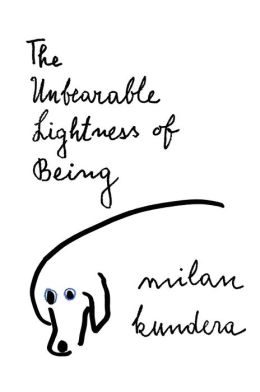
by Milan Kundera
This was one of the latest love stories I read. I think I had love story fatigue, because I didn't get into the plot very much. I also found myself not particularly interested in the characters. I can't put my finger on what it was, but each one had some sort of pathetic fault to them that just made my eyes roll constantly.
Don't get me wrong, this was still a pretty good book, but no thanks to the love story. I really love hearing Kundera's voice at carefully placed spots throughout the book. He's a little bitter about the state of Eastern Europe in the 1980s, but his anger ignites his writing. There is one part of the book where he sounds a little like Rene Descartes. Deeper in the book there is a part about God and shit; it made the book for me. I won't ruin it for you.
Kundera's philosophy drenches some beautifully crafted pose. Here's a couple of my favorite passages, and, yeah, I realize there's a bunch of stuff about love:
We can never know what to want, because, living only one life, we can neither compare it with our previous lives nor perfect it in our lives to come....What happens but once, says the German adage, might as well not have happened at all. If we have only one life to live, we might as well not have lived at all. (p. 8)
Necessity knows no magic formulae-they are all left to chance. If a love is to be unforgettable, fortuities must immediately start fluttering down to it like birds to Francis of Assisi's shoulders. (p. 49)
Sensuality is the total mobilization of the senses: an individual observes his partner intently, straining to catch every sound. (p. 54)
No, vertigo is something other than the fear of falling. It is the voice of the emptiness below us which tempts and lures us, it is the desire to, against which, terrified, we defend ourselves. (p. 60)
We might also call vertigo the intoxication of the weak.(p.76 )
Culture is perishing in overproduction, in an avalanche of words, in the madness of quantity. (p. 103)
There are things that can be accomplished only by violence. Physical love is unthinkable without violence. (p. 111)
...love means renouncing strength. (p. 112)
Surgery takes the basic imperative of the medical profession to its outermost border, where a person is clubbed on the head, he collapses and stops breathing. Some day, he will stop breathing anyway. Murder simply hastens a bit what God will eventually see to His own. God, it may be assumed, took murder into account; He did not take surgery into account. He never suspected that someone would dare to stick his hand into the mechanism He invented, wrapped carefully in skin, and sealed away from human eyes. (p. 293)
I have said before that metaphors are dangerous. Love begins with a metaphor. Which is to say, love begins at the point when a woman enters enters her first word into our poetic memory. (p. 209)
The novel is not the author's confession; it is an investigation of human life in the trap the world has become. (p. 221)
History is as light as individual human life, unbearably light, light as a feather, as dust swirling into the air, as whatever will no longer exist tomorrow. (p. 223)
Love is the longing for the half of ourselves we have lost. (Plato's 'Symposium'). (p. 239)
(about vertigo) ...when the north pole comes so close as to touch the south pole, the earth disappears and man finds himself in a void that makes his head spin and beckons him to fall.
...
If rejection and privilege are one and the same, if there is no difference between the sublime and the paltry, if the Son of God can undergo judgement for shit, then human existence loses its dimensions and becomes unbearably light.(p. 244)
And therein lies the whole of man's plight. Human time does not turn in a circle; it runs ahead in a straight line. That is why man cannot be happy: happiness is the longing for repetition. (p. 298)
5/5/08
International Masters Cup Award Winners: Images Of Nature
Award-winning photographers here are "amateurs", but only through semantics. Beautiful, eclectic gallery of pics - from animals & wildlife to wilderness & landscapes. Some really nice stuff. Page loads kind of slow and it doesn't seem you can open them to bigger sizes, but the photos are beautiful nonetheless.
see the whole gallery | digg story
see the whole gallery | digg story
Gallery crawl to spotlight arts community
From Crain's Detroit Business:
Also, check out all the galleries that will be involved at http://www.artdetroitnow.com/galleries.html
Metro Detroit has top-quality art blooming in its own backyard, yet few of us know where to find it or who creates it.Read the whole ARTICLE.
This weekend 82 arts venues will join forces to produce Art Detroit Now — a gigantic gallery crawl spanning 18 cities. The event is part of a grassroots movement to promote metro Detroit's art scene. It comes after 18 months of meetings organized by arts patron Marc Schwartz, owner of Royce Music Distribution and Shortcut ooks in Birmingham.
Also, check out all the galleries that will be involved at http://www.artdetroitnow.com/galleries.html
5/4/08
Fantasy leagues not just for sports junkies any more
I've been playing Fantasy Hockey for a couple of years now. If you don't know what Fantasy Sports are, click HERE. Bottom line: It's a fun way to waste time, although some leagues opt to make friendly wagers on the side.
For a long time, I've been noticing different types of "fantasy" leagues cropping up. There's Fantasy Congress. I tried it out for a short time, but I think the "season" lasted entire terms, so I lost interest. It looks like they've changed it up quite a bit, so it might be worth another look. Perfect for the political junkie-filled office leagues.
There is also Fafarazzi, which is a celebrity fantasy league. The "seasons" are shorter than other leagues, but so funny. You basically draft a team of celebrities and you score points when they make the headlines. I thought I was sweet because Eva's Merry Band of Bawdy Jades drafted Lindsay Lohan, Paris Hilton, Brad Pitt and Angelina Jolie. Then, my buddy drafted Britney Spears and cleaned house. Suffice to say she and I broke from the pack, yet, Britney still helped her crush me by like 200 points in the end. Another great office league selection, but with a far lighter feel.
And just the other day I found that you can now do "fantasy" trading in a similar kind of league. From http://www.thestreet.com/:
With social networking's growing popularity, it's no surprise that one of its oldest relatives is branching into all kinds of areas. Good times.
For a long time, I've been noticing different types of "fantasy" leagues cropping up. There's Fantasy Congress. I tried it out for a short time, but I think the "season" lasted entire terms, so I lost interest. It looks like they've changed it up quite a bit, so it might be worth another look. Perfect for the political junkie-filled office leagues.
There is also Fafarazzi, which is a celebrity fantasy league. The "seasons" are shorter than other leagues, but so funny. You basically draft a team of celebrities and you score points when they make the headlines. I thought I was sweet because Eva's Merry Band of Bawdy Jades drafted Lindsay Lohan, Paris Hilton, Brad Pitt and Angelina Jolie. Then, my buddy drafted Britney Spears and cleaned house. Suffice to say she and I broke from the pack, yet, Britney still helped her crush me by like 200 points in the end. Another great office league selection, but with a far lighter feel.
And just the other day I found that you can now do "fantasy" trading in a similar kind of league. From http://www.thestreet.com/:
What a great way to get your feet wet with the stock market and with no risk! I couldn't find anything that says it costs anything to join, but it seems interesting and you could win some dough.Play Beat the Street, the all-new edition of the fantasy trading game from TheStreet.com. When you do, you could be the big winner every week — up to $60,000 in cash prizes. Hurry and register now so you're sure to be in the game when it begins. Play Beat the Street!
With social networking's growing popularity, it's no surprise that one of its oldest relatives is branching into all kinds of areas. Good times.
5/3/08
20,000 vets brain injuries not listed in Pentagon tally
At least 20,000 U.S. troops who were not classified as wounded during combat in Iraq and Afghanistan have been found with signs of brain injuries, according to military and veterans records compiled by USA TODAY.
read more | digg story
read more | digg story
War Veterans
The American soldiers need to be taken care of. It's good to see that the Pentagon is starting to shape up on how they treat their psychiatric wounds (see this article about the problem and this article about the progress). I think it's too little too late. I am happy for the development, but a lot of damage has been done.
When it comes to taking care of the soldiers they send to die, the U.S. government has an uncanny ability to fudge things up on a grand scale. Something quite unfortunate always finds a way to surface. Here are some things that the American people should be aware of when it comes to caring for our soldiers:
When it comes to taking care of the soldiers they send to die, the U.S. government has an uncanny ability to fudge things up on a grand scale. Something quite unfortunate always finds a way to surface. Here are some things that the American people should be aware of when it comes to caring for our soldiers:
- Conditions at Walter Reed Hospital
- Overdose problems at Brooke Army Medical Center
- Conditions at Fort Bragg
You can add those problems at home with these problems abroad:
- suicide bombers
- Abu Ghraib, where only the peons' heads rolled, not the people giving orders
- lack of armor for the cars at the beginning of the war
- the government jumping the gun with the whole Mission Accomplished business, which by the way happened 5 years ago.

It's just folly after fib after failure. I supposed "fib" isn't the right word; it implies too much innocence. The decisions by our government directly effect every one of these things. You should know.
5/2/08
Simplicity: A little change for a big result
Lately, I've been appreciating the fantastically simple.
A few examples:
A few examples:
- Simply Perfect. I have been reading great fiction by Ray Bradbury. His writing moves you in huge emotional directions with very short, concise, but always poetic prose. And it's the subtleties of his characters that makes them so very real: the way they speak, to themselves and to others to how they feel to how the air around them smells. I will have an entire blog devoted to his novel Dandelion Wine, which I haven't even finished yet. This book has been an impetus for my writing lust.
- Simple Advice. Sit. Chip Scanlan's recent blog is great, short, simple and repeating a very regular, but important part of the writer's job: sitting.
- Simple cooking. I've been enjoying a lot of vegetable and the different flavors they make. I can't afford meat, so that works out well. Also, yogurt (plain and low-fat) with some granola is a mixture fit for the Gods.
- Simple exercise. I thought of two separate exercise examples. Everyone at work is getting ready to help with the Relay for Life. Everyone can walk, hence, everyone can help. The other simple exercise example was taking stairs at work. Believe it or not, but I got this message from this Ad Council ad.
- Which brings me finally to: Simple messages. I read and reviewed a great nonfiction book called Made to Stick. Much like this post, the book is based on simplicity. Simplicity leads to a messages stickiness. The Ad Council found a way to make taking the stairs stick in my head, which later on (a few months later) I actually took action on.
Subscribe to:
Posts (Atom)