The other day I heard an interesting New York Times Today's Business podcast about Flint, MI. The podcast was from April 21, but I couldn't locate it outside of iTunes, so I looked up this article. Basically, they are trying to save Flint by shrinking it. The idea is to consolidate it's residents by gently persuading them to move. I don't know how "gentle" it really is, since they're basically going to cut off city services to certain blocks. So if you would like a nice sidewalk, you would have to move to the areas of town that are being tended to. The article briefly mentions it and the podcast goes into the talk of turning the decrepit neighborhoods into forests. My first thought was: this might be a model for Detroit. I mean, Wayne County has like 7000 acres of land banks - throw in a little forest!
Also, I'd like to take this moment to tell Rush Limbaugh to fly a kite. What an unfortunate human being.
6/25/09
6/23/09
Book Review: The Shock Doctrine - The Rise of Disaster Capitalism
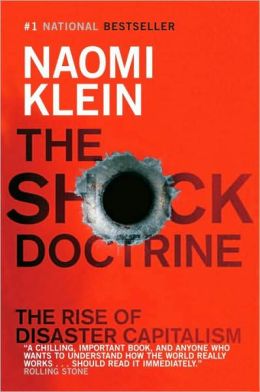
Klein makes the book's purpose clear in this early paragraph:
"This book is a challenge to the central and most cherished claim in the official story - that the triumph of deregulated capitalism has been born of freedom, that unfettered free markets go hand in hand with democracy. Instead, I will show that this fundamentalist form of capitalism has consistently been midwifed by the most brutal forms of coercion, inflicted on the collective body politic as well as on countless individual bodies. The history of the contemporary free market - better understood as the rise of corporatism - was written in shocks." (p. 18)There it is. Game over. Klein wins. She really pulls this off and the product is freaking stunning. I'm in shock and I could probably be swindled into making some bad life decisions after just reading this book. Just kidding. But it is a must read for history buffs, political junkies and economy watchers. My friend says she continues to refer to The Shock Doctrine even though it was published in 2007. The accuracy of Klein's pondering is eerie.
The Shock Doctrine is not for the weak of heart. It gives you (and hope in humanity) a swift kick to the throat over and over through recent histories backed up with painfully sound evidence. It'd be great if it was all exaggerated, but you can't make this stuff up. After one emerges from the gloom created by the reading of this book, the last ten or so pages wraps it up with hope. With all the delivery of doom, Klein does a tremendous job of putting things into perspective and actually inspiring hope in humanity. It was another brick in my belief Detroit can rise from the shock it has been in, you know, since the late sixties.
There are two particularly evil characters in this book: Milton Friedman and the Chicago School of Economics. Klein described Friedman is as the guru of unfettered capitalism. He is cast as the super villain and for good reason. He's the guy that sparked the idea of shocking a country's economy through privatization, deregulation, hollow government and completely free enterprise. Although, I am not a fan of this, I'm wondering what it will take to get Detroit back on the right path. Perhaps not a shock, but a damn wake up call is needed in Detroit government. I digress.
The other character, which spawns a slew of others throughout the book, is Friedman's homebase: the Chicago School of Economics. There only the finest crooks were molded, from leaders of junta governments to (dangerous) jokers like Donald Rumsfield. Milton and the "Chicago School" were on a crusade to spread free-wheeling capitalism and cloaked it with the word "democracy." Basically, they wanted to bank off other people's money. They did, but it is interesting to hear about their fall from grace. I'm fascinated by their failures.
Klein's perspective is brilliant. She makes many relevant connections, historical observations and she even nailed a few predictions, like how this system was going to fall apart. There's only so much people will take and only so much money you can bag before someone starts wondering where the hell it all went. Though packed tight with information, it could be read again and again and you'd learn something new each time. Klein's writing is clear and the prose pieces together a history lesson with a call to grassroots. Good stuff.
The journey that Klein takes you on in the Shock Doctrine starts in South America's Southern Cone - in Chili, Argentina and Uruguay. There's some mentions of Colombia, Bolivia and Brazil as well. Chili was Friedman's first shock experiment and there's all kinds of info on the kind of crazy stuff that went on - torture, misery villages, disapperings and American-backed coups. Not cool.
Then we are shown examples ALL OVER THE FREAKING WORLD. Seriously: China, Russia, Poland, South Africa, Lebanon, Sri Lanka, Iraq, and, of course, the United States itself. I probably missed a few. What a ride.
It was a little strange to be reading The Shock Doctrine now when it was published in 2007. Though Klein manages to let the facts speak loudly for themselves, one can tell that she is reeling throughout the book about the Bush Administration. The connections between the Administration and multinationals that have sucked the life out of the United States and the world economies are appalling. I'll just leave it at that, but that junk is well documented.
And here are a few notes that I took. I had to really restrain myself from taking too many because it would have taken me two years to finish this thing. Anyway:
"The shift has been starkest in the U.S. where CEOs made 43 times what the average worker earned in 1980, when Reagan kicked off the Friedmanite crusade. By 2005, CEOs earned 411 times as much." (p. 444)Talking about the 400,000 or so Iraqi soldiers Paul Bremer laid off after the U.S. invaded Iraq, Marine Colonel Thomas Hammes said:
"Now you have a couple hundred thousand people who are armed - because they took their weapons home with them - who know how to use the weapons, who have no future, who have a reason to be angry at you." (p. 352)A quick explanation of what shock is. It's an underlying theme throughout the work:
"A state of shock, by definition, is a moment when there is a gap between fast-moving events and the information that exists to explain them."She goes on:
"...in North America, the September 11 attacks were, at first, pure event, raw reality, unprocessed by story, narrative or anything that could bridge the gap between reality and understanding." (p. 458)Finally, this was an interesting point on Hezbollah:
"There is no question that Hezbollah is engaged in politics as well as charity, and that Iranian funds made Hezbollah's generosity possible. Equally important to its efficiency, however was Hezbollah's status as local, indigenous organization, one that rose up from the neighborhoods being rebuilt." (p. 462)There so much more great information in this book. Highly recommended for everyone.
Labels:
Books,
Business,
Capitalism,
Economy,
History,
Iraq,
Milton Friedman,
Natural Disasters,
Politics,
Terrorism,
Tsunami,
War
No comments:

6/15/09
NBC News: More using libraries
This segment aired yesterday on NBC. The only worry is that people will just think libraries will be to save money instead of enrich themselves, though as long as they visit, it really doesn't matter. Also, there's one part of this clip that makes it sound like you can drop your kid off for free entertainment, which is incorrect. (Note: NEVER LEAVE CHILDREN UNATTENDED AT LIBRARIES. Ever.) The clip also touches on how we face bigger crowds, more upset people and continue to see our budgets cut.
Visit msnbc.com for Breaking News, World News, and News about the Economy
6/3/09
Book Review: Little Brother
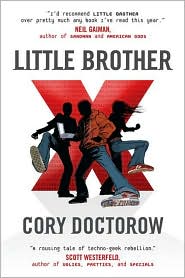 This book was enjoyable on so many levels. It's a story about Marcus, a 17-year-old techno-geek in San Francisco. One day he ditches school with some buddies and they get caught in the chaos of a terrorist attack. The four kids get detained by Homeland Security and Marcus gets the Gitmo treatment because he acts like a little tool in typical teenager fashion. Once released, he basically declares war on the Department of Homeland Security and sets out for revenge.
Marcus is the narrator and he often pauses to share quick lessons on programming, mathematics, privacy, cryptography and other technological wisdom. The idea that teenagers think they know everything just might have some truth to it, at least nowadays. These lessons are brilliant, not boring. I was inspired to check into a fact about cryptology. Starting on page 267, Marcus tells the reader:
It's unbelievable today, but there was a time when the government classed crypto as a munition and made it illegal for anyone to export or use it on a national security grounds. Get that? We used to have illegal math in this country.The author included sex, relationships, drugs and other parts of youth that ring of rebellion, but Doctorow never stops having fun. It grasped the awkwardness of the teenage years and their familiar, clumsy feel. The novel shares a quality found in most young adult books - high reading pace. Even though I'm not a teenager, I could still relate to the story because I consider myself a Millennial.
While it reminded me of my youth it also made me feel old. I'm 26. I should not feel old. However, it gives me perspective on those that are older than myself, because frankly I don't know squat about technology compared to the lil' techno-geeks growing up right now. Seriously. I have two degrees and I couldn't hack my way out of a wet paper bag.
Speaking of hacking, this book has also shed some light on hackers' thinking. It doesn't explain ALL hacking activities, but it looks at hacking through the lens of rebellion, which I thought was an interesting and enlightening concept. Further, the story supports how important hackers really are to protecting privacy. I know that sounds contradictory, but if you can hack it than you know how to prevent others from hacking it.
Speaking of hacking, this book has also shed some light on hackers' thinking. It doesn't explain ALL hacking activities, but it looks at hacking through the lens of rebellion, which I thought was an interesting and enlightening concept. Further, the story supports how important hackers really are to protecting privacy. I know that sounds contradictory, but if you can hack it than you know how to prevent others from hacking it.
It was so refreshing to FINALLY read about modern day technology in a book for once. Yeah, Sinclair, Koestler and Marquez can pull at my heart strings and boggle my mind, but can they work a BlackBerry??? No.
I'm not going to sit here and tell you that this is a fine piece of literature that deserves honors and awards. It's a young adult book. It doesn't have killer plot twists, thorough character development and seamless dialogue. No, what made this book for me was the perspective of a young person dealing with the post-9/11, terrorism witch-hunt world that we live in. I could actually hear myself asking the same questions that the characters asked themselves. It brought back the troubling thoughts pounding my brain following 9/11.
People say that this is a modern 1984 and I understand why they think that, but 1984 is a superior novel.
I'm not going to sit here and tell you that this is a fine piece of literature that deserves honors and awards. It's a young adult book. It doesn't have killer plot twists, thorough character development and seamless dialogue. No, what made this book for me was the perspective of a young person dealing with the post-9/11, terrorism witch-hunt world that we live in. I could actually hear myself asking the same questions that the characters asked themselves. It brought back the troubling thoughts pounding my brain following 9/11.
People say that this is a modern 1984 and I understand why they think that, but 1984 is a superior novel.
Subscribe to:
Posts (Atom)