7/20/08

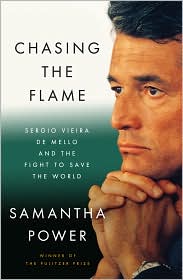
Book Review: Chasing the Flame

Chasing the Flame
by Samantha Power
After many months, yes, months, of reading this book, I have finally finished. Even though it took me a very long time, it was well worth it. I mentioned that this book shouldn't have made it through my 50-page reading rule, but that was incorrect. The 50-page reading rule did not apply here and I'll explain why later. The book was very dense with information, jammed with a multitude of references and notes, and a biography that was worthy of this great man.

Sergio Vieira de Mello was a humanitarian, peacemaker and state builder with the United Nations. He was a lifelong UN guy and went to all kinds of godforsaken places on all kinds of brutal missions: Lebanon, Cambodia, Rwanda, Kosovo, East Timor and, finally, Iraq, where he died in an Al-Qaeda attack. That's quite the resume o' misery.

Each of these missions had its own goals and every one came with unforeseen problems. A lot of this book was about Vieira de Mello learning on the job. That could easily have been part of the reason why this title was so frustrating to read. Everything seems so much more obvious in hindsight, but he was living through these tragedies and working with limited resources. Although I think he did a ton in his lifetime, it was difficult to look beyond the dysfunctions of the UN, with its red tape, bureaucracy, lame leadership and lack of international support from member states. This man proved he had some patience, cause anyone else would've gone mad.

I have quite the mixed feeling on the UN now. It's not completely their own fault, but I will fault the leadership, namely Kofi Annan, for the disastrous results of the Iraq mission. The other serious flaw with the UN is that the most powerful member states are jerks. They want to have an international group, but won't supply it with personnel, supplies, money, etc. In a sense, I understand that the UN is in theory a great idea, yet in practice destined to fail always.

I was at a street festival in Ypsilanti, MI a couple weeks back and saw this sign hanging to the right of the stage. Although I don't agree, this book made me understand why this idea persists. I also feel that Americans should look to their own leadership before casting stones at the United Nations.

Initially, I felt that Vieira de Mello was, well, kind of a piece o' crap. He was a charismatic guy, a top-notch schmoozer. He was a womanizer, regularly cheating on his wife, who he would eventually divorce much later in life. Yet, as the book went on, I realized that I was being quite unfair. Although he was not Mr. Committed to Wife, he was Mr. Committed to Work. He gave everything to his work. In the end, he sacrificed his very life.

Vieira de Mello's philosophy and diplomatic techniques were incredibly insightful. He was known for always trying be diplomatic with the bad guys to learn about them, though some faulted him for overlooking various atrocities. He learned to create solutions with minimal resources and was very vocal. Later in his life, he developed an intense philosophy on human rights, which would have served the United States very well in Iraq. He was the first one to tell Paul Bremer, a joker and large reason Iraq is what it is, that the US was poised to have some serious abuse problems. A year after Vieira de Mello's warning, the Abu Ghraib story broke.

Struggling through Vieiro de Mello's first missions seemed very counterproductive at first, but it really provided a very important foundation of understanding about the man. The last 120 pages of the book are very, very intense and that's why the 50-page reading rule does not apply to this book. As a reader, you know it's coming. You can hear the clock ticking on Vieiro de Mello's life and the author makes that ticking louder by describing that day, August 19, 2003, minute-by-minute when possible.

In the end, it is more tragic than one can imagine. I was reading the last parts of the book in a vehicle on the way back home from a trip. I worried by boyfriend because he heard me sniffling in the back seat. Vieira de Mello, even trapped under the rubble that would slowly kill him, only asked about the rest of the people in the building. He asked that the UN not pull out of Iraq. The last passage in the book is probably one of the most striking:

"When he realized he had miraculously survived the blast, he must have expected
that the professional soldiers from the most sophisticated military in history would find a way to extract him from the debris. But as his life seeped slowly out of him, there must have been a moment - hopefully not a long one - when he was every bit as helpless as millions of victims had been before him. He died under the Canal Hotel's rubble - buried beneath the weight of the United Nations itself." (p. 537)

In the end, he was just as much of a human as anyone was. The difference was that he did things that most of us never would. He was selfless, even though it always didn't seem that way, but he was.

Here are my notes from the rest of the book, with page numbers first:
  • 17 - "Audacity is the winner's gift," his dad Arnoldo Vieira de Mello said.
  • 48 - Vieira de Mello found some gaps in philisophical tools. "Things are much complicated in practice...Philosophical ideas must be applicable on the ground, and the field should be their only judge, their only criteria."
  • 59 - "Living is a prelude to death." ~Alexander "Sacha" Casella.
  • 73 - Vieiro de Mello was very into philosophy and defended his 600 page thesis. He was really into Kant, who felt that other countries should not interfere w/ others' internal affairs unless the unrest in a country begins to interfere w/ neighboring countries as was the case in 1990's.
  • 99 - at this stage in his career (90s and in Cambodia), mulling the roots of evil was more stimulating than managing the logistics of easing the suffering that resulted from that evil.
  • 100 Sergio a man who refused to make enemies
  • 199 - by this point in the book, he's gone to Lebanon, Cambodia, Bosnia and new Rwanda. All this time the picture I see developing before me is one of external ignorance. The UN, though a good idea, doesn't seem to pan out in real life. So far they just watch situations deteriorate and then kind of play it by ear, but these are enormous catastrophes. I suppose there really is no easy way to deal with tragedy, despair, emergencies, famine, etc.
  • 206 generally all the world's countries turning their backs on each other.
  • 213 - "we have to choose the least bad option here." Sounds like every UN mission.
  • 358 - it seems like he won many small battles, which from the tone of the book sounds impossible. He gets some kind of 2nd wind in 2001, divorced his wife, marries some 20-something he worked with at the UN. Got much more spiritual, very different from his atheist attitude of before.
  • 361 - I never realized how much Bin Laden hated the UN. He said "under no circumstance should any Muslim or sane person resort to the United Nations. The United Nations is nothing but a tool of crime."
  • 471 - as he lay under rubble, thirsty, with only one arm free, he asks about "the others." He just received his tickets to go to Brazil to visit his mom a day or two before.
  • 526 - Vieira de Mello had said, "Think of how hard it is for any of us to change. Why do we expect it to be easier for a war criminal?"

Today's Knowledge: Now on sale - HUMAN LIFE!

For all you needing a life, now is the time to buy!

From the Washington Post article "Cosmic Markdown: EPA Says Life Is Worth Less":
Last week, it was revealed that an Environmental Protection Agency office had lowered its official estimate of life's value, from about $8.04 million to about $7.22 million.
What a bargain.

7/19/08

Today's Knowledge: Holy water used regularly in football

No, I'm not talking about American football. I'm talking about the game in which you actually use your FEET to play, a.k.a. soccer.

Anyway, I don't know if it's holy water, water from the fountain of life, or just your run of the mill nectar of the gods, but whatever football training staffs use on their injured players, it works. Watch any football game and pay close attention the player who drops to the ground, contorts his face into a pained expression and rolls around in agony while clutching his "injury." The trainer will hurry over, talk to him a little, and then hose the alleged injury down with this healing liquid, which looks a lot like bottled water. The player then calms down and continues with the game.

I still love football, but come on.

7/18/08

Today's Knowledge: Stop-Loss and the Iraq War

Just in case you didn't know, the Iraq War is a train wreck. There's all sorts of facts, figures and stories that back this up, but to me the people getting hurt the most (tied only with Iraqi civilians) are our brave military men and women that are fighting this losing battle.

I just learned this new term: stop-loss. Stop-loss is essential when the military tells soldiers that even though they have fulfilled their voluntary duty, they have to go back and serve extra time. I was catching up on my podcasts and learned about all this stuff on Democracynow.org. You can view or listen to (or read the transcript) of the whole show and lots of other stuff there. The story is call: Stop-Loss: A Look at the US Military Policy that Creates a “Backdoor Draft” to Force Soldiers to Continue.

There's a couple different things that you should check out regarding this issue. First, check out Casey J. Porter's YouTube channel. He was stop-lossed three weeks before he was getting out. Now he's in Iraq filming the thoughts and lives of soldiers. You can hear the truth from the soldiers on the ground at his channel: http://www.youtube.com/CaseyJPorter. Very important stuff. Very important work.

Another soldier, Colby Buzzell, was also recently stop-lossed. He is the author of the blog My War: Killing Time in Iraq and he also wrote a book by the same title. He wanted to use his G.I. Bill to get into college and start his life outside of the military. Instead, he's getting shipped back to that US-made mess.

Finally, there's a movie that came out on DVD called Stop-Loss. It was an MTV production, so I think initially I ignored it for that reason, but I'm about to go check it out. I caught a clip of it on Democracy Now and definitely think it's going to be good.

7/17/08

Today's Knowledge: Poems for the Summer

Happy Ozone Action Day! Check out all these great poems for the summer at Poets.org. And enjoy this Sonnet by the big man:

Shall I compare thee to a summer's day? (Sonnet 18)
by William Shakespeare

Shall I compare thee to a summer's day?
Thou art more lovely and more temperate.
Rough winds do shake the darling buds of May,
And summer's lease hath all too short a date.
Sometime too hot the eye of heaven shines,
And often is his gold complexion dimmed;
And every fair from fair sometime declines,
By chance, or nature's changing course, untrimmed;
But thy eternal summer shall not fade,
Nor lose possession of that fair thou ow'st,
Nor shall death brag thou wand'rest in his shade,
When in eternal lines to Time thou grow'st.
So long as men can breathe, or eyes can see,
So long lives this, and this gives life to thee.

7/16/08

Book Review: Thank You For Smoking

Thank You For Smoking
By Christopher Buckley

This book was really great for me for a variety of reasons. The reading of it was perfectly timed. The writing of it was masterfully done and playful all the while. The characters' behaviors are absurd, but not enough to be unrealistic. The book really picks up about halfway through. It was very quick reading and I never once thought about my 50-page rule. Plus, as evidenced in this review, this book was a very personal reading experience for me.

Nick Naylor, the main character, is a tobacco lobbyist and a brilliant one at that. However, he's on the hot seat at work right up until he gets kidnapped and tortured by "gaspers", those who are crusading against Big Tobacco. He somehow spins it and becomes a, well, I guess a hero in the land of tobacco? It's strange and bizarre.

Nick's a player and he's always thinking about women. This book had a little bit more sex that I'm comfortable with, but for some reason it didn't piss me off this time. I think the author did a good job of making the sex scenes kind of...cartoon-ish? Babes are attracted to him like moths toward flame. The more raises and responsibilities and pats on the back from "The Captain" Nick gets, the more action he gets. There's a couple of twists and turns and, well, no spoiler here, sorry. The twist is actually pretty easy to spot, but that didn't ruin the novel for me at all.

Finally, he's part of the MOD Squad - the Merchants of Death. It includes him, representing the tobacco lobby, and then a lobbyist for alcohol and for the gun lobby. This bunch is really entertaining as they talk about their work woes. Plus, their friendship is genuine. They're not always nice to each other and they're always honest with each other. Their interactions were my favorite part of the novel.
My boss, Rev. Ice D, recommended this book when he read that I was looking for a pick-me-upper. It was about the same time I reviewed The Natural. I picked that book up thinking "Field of Dreams" and instead got baseball noir. The Natural was great, don't get me wrong, but it was no pick-me-upper. Initially, I really didn't think Thank you for Smoking wasn't either. It was pretty damned funny, but it sort of sent me on a warpath at the same time.

[Warning: The "smoking sucks" rant begins here]

I started reading this book at a very interesting time. In my post Smoking and Suffering, I described how cigarettes effected my health. I was eyeball deep in this book and it was the final straw for me. Although the main character was brilliant in many ways - hustler that would make Jay-Z proud - I knew he and his army of death merchants shouldn't fool me, or anyone! I knew I could be smarter by simply learning from my own experience. I wheezed when I did yoga. I was out of breath at the top of the stairs. I don't need scientific data to tell me smoking is bad - ten years of doing it made that clear! But it shows how the most wealthy and powerful industries can find the smartest people, the best con artists to get the job done. I know that this is a work of fiction, but frankly, it doesn't seem like it's too far off the mark.

Allow me to be honest for a moment: I know that there's people out there waaaayyyyy smarter than I am, but a tobacco lobbyist is NOT one of those people! I shall no longer be yanked around by their stinking propaganda. It is my hope that others can also break free from Big Tobacco's hold. It's hard. It's worth it.

7/12/08

My 50-page Reading Rule

As a rule, I will give a book 50 pages to prove to me it's not lame. I mandated this practice after reading 350 pages of a 1400-page version of War and Peace. I never made it through that "masterpiece" and for good reason: every time I sat down to read it I either passed out (although it help to cure my insomnia at the time, so thanks Tolstoy, I guess) or I got completely lost/bored with the long, long list of characters and web of Russian politics. I really don't know what I was thinking. I was young.

After many years of being in school and reading textbooks (hardly the best pleasure reading material) and coma-inducing research articles, I promised myself that I would reserve my post-graduation reading for things that grab my attention and fascinate me. I wanted stories that tickle my imagination, characters that I love/hate, plots that kept me guessing, non-fiction that made me say "wow" or "I'm contacting my Senators and Representatives RIGHT NOW." I just want things that nurture my intellect while keeping me engaged, not ones that tuck me in to sleep.

These titles did NOT make it passed the 50-page reading rule because they were painful to read:
  • Electric Acid Kool Aid Test by Tom Wolfe - OK, so I lie. I actually got through like 70 pages of this book because I thought the hippies were going to get busted by the feds. They didn't and I quit due to disappointment. If you love stupid hippies, run on sentences, mindless acid-spawned blather and a book with no plot, then this one's for you.
  • House on Mango Street by Sandra Cisneros - I thought I'd like this book for two reasons - it was on the "Summer Reading" list for SPL and it was super short. Well, it wasn't short enough. I made it to about 20 pages of a book with HUGE writing on small pages. Terrible.
  • How did I get so busy? by Valorie Burton - One breeze through this book and I thought, "Wow, is it really this easy to write a book?" If you have little to no common sense, this title might be worth your while, but I picked up nothing new.
  • 4-hour work week by Timothy Ferriss - The title should give you a hint that this is too good to be true. Basically, this guy is a pseudo-con artist. He doesn't hurt anyone, but he finds all these super lame ways to get what he wants. Example: he wins a martial arts contest by pushing his opponent out of the ring, winning on a technicality rather than by kicking ass. Plus, he's preachy. Plus, there's little to no chance of any of us having the luck that he has. If you've got nothing to lose, you might find something worthwhile in this book. I'm just kidding - you won't.
  • Atlas Shrugged - Not being able to get through much of this one saddened me. The Tamil Punkster, my favorite punkster of them all, recommended this. I respect her as a friend and an intellectual, but I just couldn't get into this book. It's like a million pages, too, so I didn't want to repeat my War and Peace fiasco.
Books that I should not have finished, but did:
  • Bad News by Tom Fenton - Bah! Dang TV people can't write worth a damn and this is proof. It was full of good information, but you can look at my review on it.
  • Chasing the Flame - Yeah, I'm still reading this one. Started this baby in April and after many torturous months I continue to struggle with it.
  • Confessions of a Video Vixen - Well, I'm not a big on the floozies, but my patrons were CRAZY about this book (and her follow up Vixen Diaries as well). Hence, I chalked reading this book up to "research." Very fast read and a waste of time. Bawdy jades are all the same - gross.
Books that should make it passed the 50-page rule, but I can't get into them, but I love the author or topic, so I just put them aside and SWEAR that one day I'll read them all the way through, even though I know damn well I won't:
  • Loathing the Campaign Trail '72 by Hunter S. Thompson - I am a political junkie, but this is just a bit too out of context for me.
  • Pentagon Papers - I got through a lot of this actually, but it's raw government report data and although it was appalling, it was boring, too.

One book that I am totally ashamed for not finishing because it was fantastically interesting, but mega-long (what can I say - I was an undergraduate) was a biography on Al Capone by Laurence Bergreen. Very engaging, packed with gritty detail, about a REAL gangster and placed in this lil' town I love called Chicago. Someone asked me, "So was he misunderstood or genuinely evil?" Even though I didn't make it all the way through the book I knew the answer was the latter.

Smoking and Suffering

"Never to suffer would never to have been blessed."
The homeboy Edgar Allan Poe said that. It's one of my favorite quotes by him and it's just right for this matter.

About 9 months ago, I made the most serious attempt to quit smoking to date. I went about 2 months without a single cigarette. I stopped having them after meals, while driving and while having conversations. I started to have one here and there after enjoying some party beverages. Party beverages and cigarettes are natural partners in pleasure.

Smokes were always around, because people that are very close to me continue to smoke. Plus, being that Michigan is stuck in the Dark Ages, you can still smoke in public places. Yet, even though I smoked one here or there, or on a bad night I'd smoke up to five or six, I still kept it under control and continued to not smoke throughout the week.

At the beginning of this month I came across a very strange realization: my body physically rejects cigarettes. I'm not completely sure what happened, but on July 2 I had a cigarette. Just one. Moments later, my mouth began to water and a familiar metallic flavor developed. I ran to the bathroom and vomited. I blamed the chunk-blowing on some Pierogi that I had.

The next day I once again smoked a cigarette. Yeah, I know - it wasn't one of my brightest moments. The exact same thing happened as the day before. Very unpleasant.

At this point one would think that I got the message from my body and maybe took the hint. Instead, on the Fourth of July I enjoyed party beverages at a cookout and smoked at LEAST ten cigarettes. TEN CIGARETTES! No, I did not project vomit after that smoke-off, but something equally lame and crappy happened to me: both of my tonsils became inflamed.

My left tonsil was the first victim of the death sticks. It swelled to the size of a marble and was uncomfortable, but not terribly painful. After a couple days of coughing up colorful mucus, my left tonsil returned to normal size. Meanwhile, my RIGHT tonsil followed its neighbor's lead. Yet, Mr. Right Tonsil came with a vengeance. It swelled bigger. It created more pus and rainbow colored mucus than Lefty. And it hurt. It hurt for days and it hurt a lot. Yesterday my mood was fouled by the fact that the natural act of swallowing saliva included terrible pain at each pass. I couldn't yawn because it required stretching the inflamed tissue, and Mr. Right Tonsil wasn't having that.

After days of not smoking and drinking gallon after gallon of water, I am finally better. The right tonsil is still swollen, but I can swallow easily and am not producing mucus in appalling amounts.

Yawning is still a little bit tough, but I can manage to get a little bit of oxygen to my brain.
Alas, my suffering is my blessing. I'd like to think that this will stop me from smoking in the future, but I'm a realist. I smoked for ten years before getting my head out of the smoking cloud. It is my body that knows what's good for me, while my mind still whispers "Just one won't hurt." Well, turns out, it just might.

The battle rages on.

7/11/08

Running: My Initial Starts and Stops

Getting into running is one of the most difficult things I've ever done. It's right up there with trying to quit smoking. It's also one of the greatest things I've ever done. Running has a very strange addictive quality. There's some serious endorphins being released and it energizes me like nothing else. Once I was into my second and third weeks, I found it easier to make running a permanent fixture in my schedule. However, I fell off the wagon and now must climb back on.

For all of June I was on the injured reserve list. I strained my groin muscle while running and it hurt extra bad because it was stupid-induced. It happened Memorial Day weekend. I enjoyed some party beverages one day and slept in the next. The next day I hopped out of bed, did a quick 5-minute walk and then ran - no stretching, no hydration before, nothing smart.
I returned home invigorated and decided that I had enough energy for a bike ride; hangover be damned! That day I pushed my body when I should have slowed down, realized something wasn't right and rested. The entire work week following Memorial Day weekend I hobbled from destination to destination. The pain on the inside of my leg nagged me for weeks.
This isn't my first running injury. I'm an amateur and it shows. I started running in early April and I'm already falling apart. A week into my program, my childhood nightmare returned: shin splints. I had to sit out a few days while my shins healed; for the first time they actually swelled. I corrected the problem by running more on grass rather than pounding on cement. My legs eventually got used to it and I could run on whichever I fancied. I then strained a muscle and didn't exercise for over a month. Lame.
There is hope for me though. My guide through this world of running has been Rough Guide to Running. When the book was ready for me at the library, someone left me a cute note that said: "Running is Rough!" The book is a great resource and I highly recommend it for anyone that's looking to pick up running. A couple things I learned:
  • Your first run will be your worst. Don't get discouraged.
  • Spend some good money on good shoes. Go to a store specifically for runners so that the salesperson is knowledgeable about what shoe will fit your routine best.
  • Warm-up should last about 20 minutes, otherwise, you can end up like me with a stupid-induced groin strain.
  • Stretch after you warm up. DO NOT stretch cold muscles, as this can also lead to stupid-induced strains or pulls.
  • Drink water about an hour BEFORE you run so you don't dehydrate. Drinking it an hour before you go out will help prevent cramps.
  • Decide what kind of running path you want. Cement is really tough on the joints (and shins!), while treadmill running (not even considered running by real runners) burns significantly fewer calories and can even mess up your stride for actual running.
Further, this book provides you with great start up charts. The first phase is great for beginners. It starts you off doing a nice mix of running and walking and it also gets you used to timing yourself. It gradually has you running for longer periods over four weeks. The next phase is for folks that can already run 15 minutes at a time or have completed the first phase.
As far as my running goes, right now I'm not. I'm back on the bicycle and doing yoga again, but I'm going to save running until I get a nice, proper pair of running shoes. I'm not at all interested in discovering the variety of other running injuries out there.

7/10/08

Today's Knowledge: We are not alone in dire times

There's about 4,503,299,203,181 reasons I love National Public Radio (NPR). One of those reasons is that I can podcast episodes and listen to them whenever. This is the case with what I'm about to share.

It is no secret that we are in an economic crisis. I'm not afraid to call it what it is: it's a recession and I bet it's teetering on depression if you go to the right neighborhood. Granted, I'm not economist, but I see the writing on the wall. Food prices have gone through the roof. Needless to say I'm on a strict diet of "whatever-the-hell-I-can-afford." Energy prices as always rise in the summer. Although I have a delightful central air conditioning system, my significant other and I have indeed endured some sweaty days to save dough. And gasoline, well, don't even get me started on gas prices. Then of course there's the mortgage crisis, unemployment, failing schools, corrupt politicians...the list of rough stuff is a beefy one.

Though sometimes I feel like I'm the only one in the world struggling along, I know that's not true. I am surviving. I am living, not in luxury, but living happily. There are some parts of my life that have changed and I've accepted those changes as necessary. I shake my head at those who still roll in SUVs and I scoff at those who speed on the highway. I take my bike when I can. I plan out dinners in advance, making sure to go grocery shopping only when I need to and get only what I will use. No room for waste. No money for it, either.

When I heard this June 19th podcast called Voices on the Economy it comforted me. I am not alone in this struggle and neither is anyone else. People are changing all around me and the times, they too are a changing. This is a great 10-minute podcast and it will help you cope if you, too, are finding that you must change.

7/9/08

Kindle: the technology and hubbub

A combination of research on Amazon's electronic book reader, the Kindle, and the Atlantic Magazine article about Google making us dumber took this blog in directions unforeseen. My initial thoughts were about how Kindles would be used in a library, specifically the Southfield Public Library. Those thoughts will be shared in another post. Due to my gadget-loving nature I also thought Kindles were cool and hip, but then I thought about the intellectual property issues surrounding such digital distribution. That moved my thoughts to the music industry, copyright and of course the writing industry. This rabbit hole went deep and it was messy.

Krugman & Intellectual Property Matters
Paul Krugman, columnist for the New York Times, first made me think about writing on this topic, a topic that split into many. He wrote a brief column about the Kindle and offered a short discussion about how intellectual property laws are going to have to change with technology. He used the newspaper industry as an example of the struggle to give intellectual property away online in exchange for ad revenue, but he still sort of leaned on that model. I have some qualms giving away intellectual property and building a business model around that practice. Much of my worry stemmed from journalism's dilemmas. This model doesn't sound all that mad, but it sounds like things could go seriously wrong, especially for content creators - writers, musicians, etc.

Krugman received interesting feedback on his column. The New York Times published letters to the editor three days after Krugman's column; they were pretty good. One mentioned the fact that there are many writers who can't write for a living and have to do something else. This inevitably led to less time for the writing process. Another writer wrote about how easy it would be to zip through text on a electronic reader. I thought this a great point; I love Control+F.

The same day the letters were published, there was a blog that brought up some very excellent points about content having high value and Krugman denying that fact in his column. The post wrapped up strong:

Krugman's article is based on the premise that intellectual property will become worthless, that the real money is made selling ancillary products. His example is the Grateful Dead, which makes its money not from its music but from sales of tshirts and memorabilia. We don't buy it for a minute. Great content has value in and of itself. Harry Potter's adventures will sell, even without any related tshirts, bookmarks and action figures. Content has value as does the intellectual property of writers and songwriters. Don't let anyone tell you otherwise.

With all this in mind, my brain still whined "We've got to get a Kindle!!! It's just as important as iPod or BlackBerry!" I calmed it down by gently agreeing that yes it would be amazing to have a device like this, but that it's a little too cutting edge (read: expensive, plus, I'm a librarian for crying out loud). I would be an early adopter if I could afford it. I seriously feel that these gadgets are going to do one of two things: either they will make me and a bunch of other people fantastically successful and happy or they will destroy me and the rest of mankind, like in the Matrix.

Kindle's Technology
All these issues sort of swirled around in my brain and I decided it was time to find some reviews on the Kindle. The first one I found was in the May issue of Scientific American and it was fascinating. The article, called "Working Knowledge: Inside the Kindle E-Book Reader," described the technology that both the Kindle and Sony Reader are using: electronic paper. This stuff apparently catches light quite like the texture of paper. It is also very energy efficient: one battery will allow the user to turn 7,500 pages. Obviously downloading the books requires more energy, but that's still pretty cool technology. And if you get the Kindle, you can get those books or newspapers and magazine subscriptions through a wireless network. Instant gratification for reading urges? Would this help people read more or be distracted more? I personally would friggin' adore this thing. And be completely distracted by it.

In the May 20 issue of Forbes, the blog post "Amazon’s Kindle hopes to become the iPod of books" takes a look at some business implications Kindle might create for Amazon. This article made me grumble a little, because it first made me think of how Amazon as a business entity bungled tapping the world of libraries for their hot, hot business. Memo to Amazon: We need you as much as you need us! Someone better have lost their job for that genius move.

Now Amazon's looking to make up for it. The article rekindled (no pun intended) my worries about how technology is forcing change, which may or may not be a bad thing. I'm a little on the fence until I hear what more writers think about this. It should be no surprise that the first example offered by the article is the iPod and how it changed the music industry. Not all musicians are too crazy about the changes imposed by innovation. The Kindle wants to be the iPod of reading, which will indeed have an effect on writers.

Survey says...
I also looked to the blogosphere to learn about other people's use of Kindles. Did they like the product? Was it dependable, etc? I have yet to see one up close and personal. I found this very informative and honest look at the Kindle:

7/8/08

Librarians feel used by Google?

I ran across a most interesting post the other day. Steven Cohen, author of the blog Library Stuff claimed he felt libraries were used and abused by Google. It portrays Google as this slick con artist and the librarians its victims. I didn't agree with it at all, but, alas, I am but a loyal minion of Google. There's a fantastic discussion in this posts' comments, so check it out.

I am totally flustered at why librarians are so upset that they're not getting paid attention to by Google. Is their little newsletter from Google that critical? Dude, seriously, who cares? Google does so much for librarians in making things easier to search for both us and the patrons. It provides all kinds of fantastic services like maps, word processing, spreadsheets, web-building, free jumbo email, chat client, calendars, etc.

Google doesn't owe us sh*t. They are a business and I think that if we were a little more business savvy and not so high, mighty and noble, we could understand that. Nothing comes for free. Oh, except Google products.

7/7/08

China's Manufactured Landscapes

As the Summer Olympics approach, China is getting all sorts of publicity - good and bad, of course. One of the most interesting topics - besides human rights violations and tragedy via natural disasters - has been architecture. From what I've heard, China's architecture is nothing to write home to.

There are exceptions, of course. The Washington Post's Travis Fox highlights five amazing and sometimes outlandish buildings in Beijing in this video.


Back in June, The New Yorker also had a interesting piece about architecture in China and how the coolest buildings were created by foreign firms. I didn't catch the article, but was fascinated by the podcast with the author, Paul Goldberger. Definitely worth a listen, especially for you Olympics nuts out there.

Finally, I have been meaning to watch Manufactured Landscapes, a film that follows artist Edward Burtynsky through China as he documents the country's immense industrial revolution and it's impact on the environment and its people. I've already checked it out once and never got to watching it. I'm a lame a**. Looks visually stunning.

7/6/08

Book Review: The New Yorkers

The New Yorkers
By Cathleen Schine

Once again I judged a book by it's cover, though this time I did not get burned too bad. It was a chick read, so that was slightly lame, but it was very light reading, it took place in the greatest city in the world and it also included tons and tons of dogs.

The story weaves in and out of a group of New Yorkers' lives. The chick read aspects include crushes, break ups, divorces, light stalking, secret longing and age differences. There's very minimal sex, which is always a plus. There's fun descriptions of New York, though not a ton. And, as with practically every story about New York, I still wonder what the hell these people do for a living. One of the characters is a school teacher, but how exactly does a school teacher afford living in Manhattan's Lower East side so close to Central Park.

There was a nice, natural and contemporary touch with the blackout. One forgets how close that was to 9/11 and how much it must have freaked New Yorkers out, as was portrayed in the book. It also reminded me of how hot that summer was.

Although there was a variety of relationships in the book, one I found mos interesting was that of Polly, 26, and Everett who has a daughter just about 6 years younger than Polly. Age always matters. It might not be negative, but it always matters. In the book, that fact shines when Polly wonders why Everett talks about his daughter all the time, thinking it unnatural. I was a bit astounded by that flaw in the character, because I'm 26 and I thought it completely natural.

The book definitely brings out how happy dogs make humans; that was easily my favorite part. Dogs make people happy and people make people miserable. They are only human, of course.

This was not a thought-provoking piece and didn't strike me as a great book. If you're not a chick and you don't love dogs, this probably isn't for you. There was, however, one particularly great passage that I enjoyed:
"Has it ever occurred to you that bossiness is a kind of generosity? A need to share what the gods have miraculously bestowed?" (p. 81)

7/4/08

Fireworks Safety

Fireworks Fact Sheet
Source: Consumer Product Safety Commission

To help consumers use fireworks more safely, the CPSC offers these recommendations:
  • Do not allow young children to play with fire-works under any circumstances. Sparklers, considered by many the ideal “safe” firework for the young, burn at very high temperatures and can easily ignite clothing. Children cannot understand the danger involved and cannot act appropriately in case of emergency.
  • Older children should only be permitted to use fireworks under close adult supervision. Do not allow any running or horseplay
  • Light fireworks outdoors in a clear area away from houses, dry leaves or grass and flammable materials.
  • Keep a bucket of water nearby for emergencies and for pouring on fireworks that don’t go off.
  • Do not try to relight or handle malfunctioning fireworks. Douse and soak them with water and throw them away.
  • Be sure other people are out of range before lighting fireworks.
  • Never ignite fireworks in a container, especially a glass or metal container.
  • Keep unused fireworks away from firing areas.
  • Store fireworks in a dry, cool place. Check instructions for special storage directions.
  • Observe local laws.
  • Never have any portion of your body directly over a firework while lighting.
  • Don’t experiment with homemade fireworks.

Today's Knowledge: Global Warming and Worker Safety

I don't mean to be a bummer on the Fourth of July, but whether we are hanging out at cookouts and shooting off fireworks or not - there are serious and grave issues that still surround us. Listen to and/or watch this Bill Moyers episode that covers both Global Warming and Worker Safety. Grim - yes. Important - definitely. My hope is that reporting like this will reach and infuriate the masses.

Read, watch and learn more at: http://www.pbs.org/moyers/journal/06272008/watch.html

7/3/08

LinkedIn: My Take

On the long passed recommendation of T-Bone, I finally joined LinkedIn, whose mission is "to help you be more effective in your daily work and open doors to opportunities using the professional relationships you already have." I was ashamed it took this long, but after a week of using it, I'm not completely convinced I was missing out on anything particularly critical.

My connections list is not a bad piece of work, but I have had trouble adding some of my most important contacts; some of my past clients have told me that this site is blocked by their work. Another thing I kind of don't like - no, wait - hate is this email connection business. If I wanted to just email these people I would use my friggin' email. That's why I want them to get the message on LinkedIn, not in their email box.

Finally, I have already talked to a couple of people that are having trouble recommending me (insert "you suck" jokes here). I have asked them and they have had trouble with the link and the website keeps dropping errors on them. That's nice: I'm trying to get recommendations and it's only frustrating the people that I'm asking. That's real nice. Hence, the "social" part of this website is awkward and not fantastically user-friendly, at least not for me and my peeps just yet.

Of course, I scoured the Internet to see what others are saying and it's a mixed bag. Some people love it. Some people think it's lame and boring. Some find incredible opportunities with it and others are just on it to show up. Right now, I'm just using it as an online resume, mainly because I'm a bit to lazy to put one together myself. Check out my public LinkedIn site at http://www.linkedin.com/in/evagro.

Here's some additional reading you might want to check out about LinkedIn: